Showing posts with label shark. Show all posts

Saturday, November 14, 2020

Stone Stories #1

The serpents were fighting again, this time over eggs, their own eggs or maybe it was the muttonbird’s eggs, laid in burrows on the island. They writhed and rolled through the sound, smashing boulders and letting the water in to the place where once there was a wooded valley with a creek running through. Jarrah maybe. I don’t know. It’s been flooded for a while now and that was all the work of the snakes.

One of the water snakes shone like paua shell, glossy with the rushing water, given the incoming tide. The other snake could see her reflection in her partner and tormentor. Her skin was reddish brown like the bloodwood kina and soon, after he bit her and slid back to examine the wound, in a rare moment of comradery given what had been happening for the last seven days, nodded to her as she watched her wound sprout blood in the mirror sheen of his hide.

She wanted to kill him then, kill his glee in her damage and, knowing she could never kill him, that killing her fellow progenitor would cause their mutual extinction, she burrowed into the earth to escape. Her skin became ruddier as she nosed through deep black sand and deeper into the white sand of sea dunes. She swam under the mountain, beneath granite tors and found the underground stream, followed the stream gulping at the sweet water rich with minerals to keep her going. Behind her, there was a rumbling sound. 

He followed the path she made under the mountain and then swam along the underground stream, now red with her blood. He knew from the dank scent that she was failing.

She burst out the north flank of crow mountain. She asked the people to help her. They wore cloaks and stood in a small circle, looking shocked, their sticks shipped to their sides. We don’t dare, one of them said. What if he comes after us next?

Distract him then, she said as the rumbling under the mountain grew louder. She slid away, through the reeds of the wetlands, past the Big Tree and into the creek. She knew this creek flowed into a lake filled with yakka tortoises. She knew this because she had made it herself. Dug it out to let the water flow when the water rose up that time. Here and now, she rested a bit, hoping the people would make good on their promise. The little fish gathered, nibbling at her body, and it felt like a sweet massage.

When he came out of the mountain, he wasn’t gasping like her. He emerged straight into the sky, his colours pulsing in the sun. Where is she? He asked the people and they just looked at him. They didn’t seem to know what to say. A kid with windblown hair raised her arm, like she was about to point out the lady serpent but she was cuffed and she dropped her hand and looked at her feet. He looked down and saw the track of brushed aside rushes in the wetlands. He was fully emerged from the mountain now and towering above them. Where is she?

One man picked up his dog, cradled the dog, whispered into its ear. As the serpent took off through the rushes, the man threw his dog into the air. The dog howled and flailed as it landed in the serpent’s path. He had to either go around the dog or stop to inspect a likely feed. He bit the dog in half, swallowing the torso and flung the tail and the head back at the people in reproach.

*

The rock in the shape of a dog’s head stands in the place where all that business with the serpents happened. The main road runs so close to Dog Rock that the town council painted a luminous white collar around its base, ostensibly so drivers don’t run into it. The rock sells postcards, advertisements for car yards and tourist moments. Whenever there is talk about removing the collar citing cultural concerns, the council overrides, citing safety concerns. Yarn bombers knitted the dog a new collar and that was removed, citing safety concerns. 


Two hundred metres south is the church, attended on Sundays by processions of families and led by men in robes, carrying sticks. Outside the church is the dog’s tail. It’s a tall, upright monolyth of granite. A rectangular cavity was carved into the dog’s tail and inside that grotto stands the Virgin Mary. 

Recently, but not so recent as the epic battle between the snakes, someone stole the Virgin Mary. The thieves carved away the concrete that bound her feet to the granite, and took her away. It was considered by many as an act of desecration.

There are rumours of tunnels under the crow mountain, dug out during the war to help soldiers move around unseen.


Tuesday, March 11, 2014

Republished


My book Salt Story sold out after eight weeks which was kinda cool and awful all at once. People were asking me in the supermarket how to get hold of it and it's scarcity made it valuable.
But it's back! A second edition hit Australian shelves this week. It was quite lovely for me to open the book and read in the frontispiece: 'Republished 2014.'
Apparently Salt Story was the fastest selling new release from Fremantle Press for 2013/2014.

Whoo!
(Jumps on her computer chair. Has a bit of a dance. Falls off.)

Saturday, January 4, 2014

Stop fondling the shark hook

(I've just appropriated this new title from the No Fibs website {here} who reblogged this post this morning. Fair swap hey?)

Because I recently became an expert in great white shark management on the south coast of West Australia ...
Okay, let's start again, shall we?

Because I recently released a book about fishing on the south coast of West Australia and sporadically mentioned the Noahs that grind around the Sound looking for seals, people have been coming up to me in the street and asking what I reckon about the State Premier's latest plan to bait great whites that get closer than one kilometre off the metropolitan coast, and contract commercial fishers to kill them.

When these questions first started, I would look blankly at the person. Why ask me, was my first thought. My second thought was, why are you even asking this question? It's stupid. My third thought was 'the day when a great white shark bails me up while I'm shopping in York Street and bites me in half, I will demand that they hang it from the nearest baited hook and fire guns at it from a very great height.'

Today, over four thousand people collected on the shores of one of the most populated beaches of Perth to protest against the state government's move to kill sharks that venture too close to our shores.

 Photo: Rebecca Dollery ABC

Some people get eaten by sharks. Not very many though. I could give you the stats on the amount of sharks who die every year for fish and chips and soup compared to the people who get bitten by them but I can't be bothered and you can find them pretty easily anyway. It's somewhere within the vicinity of 100,000 to 3.

I have seen a shark killed by bounty hunters and hung from its tail by ropes on the town jetty, all of her liveborn babies spilling out of her guts in front of a crowd with cameras. I've seen their dead bodies formaldehyded in sagging, sad circuses, their jaws propped open with sticks to display the horror and morbidity of their existance. These were the moments in my life when I understood the human drive to humiliate and kill off our only predators left.

The protest today was not so much about protecting our predators, as the state government's aggressive action against them. I can't even work out how the state government has wrangled a deal where they can kill a legally protected, endangered species. Don't certain great whites have to be declared a menace to us fun-loving, beachy sorts, to be shot on sight? The latest prerequisite seems to be that, if you are a shark over three metres long and hanging out within a kilometre of a beach anywhere near the city, you are dead meat.

Anyway, today's turnout was heartening. Thanks to all the folk in the city who let Colin Barnett know that his new macho/politico shark killing exercise in the name of tourism and crime prevention is just so not fucking okay. And as a confirmed fisherwoman, the footage of him fondling that shark hook for the media was disgusting.


In case any of my blogger mates have missed this, here is the link to Val Plumwood's essay about being attacked by an apex predator. Being Prey. It's brilliant.

And here's a link to today's protest: If you have fifteen minutes to spare, watch the video. It is a great overview of what is going on here. http://www.abc.net.au/news/2014-01-04/shark-protests/5184730http://www.abc.net.au/news/2014-01-04/shark-protests/5184730

Thursday, November 28, 2013

Cambodian street shooting rig

After the launch of Salt Story (normal service will be resumed soon, I promise, I've just got to bang on about this book a bit longer) I took off to the bush to finish off another writing project; using a solar powered laptop, my lovely shack, red wine and roasted almonds to sustain me.


While I was out there, mobile range was pretty dodgey. I could get text messages but had to drive into town every day or so to check my emails. Here is a really good one from Shark, aka Mark Roy:

"Sarah
Congrats on a fabulous opening night. I picked up a copy of your book at the bookshop and its just excellent. The writing is earthy and evocative but still that eensy bit elusive. Little eddies of mystery ... Anyways here are some photos. (They) are pretty gritty as I only had my Cambodian street shooting rig. So they're rough, wide and grainy. I was pushing shit uphill with the proverbial twig to register any light at all with only an f4 lens in that room."

That's me; always a crooked pirate lass.

While everyone else gathered inside to listen to speeches, one soul had more sense. This picture reminds me of Jonathon Seagull, for some reason.

Vern, who did the Welcome to Country. Doust, who spoke impromptu and beautifully too. Harley who launched Salt Story and Soraya from the Albany Library. There may be a bookseller lurking in the background.


My true salt sister Aussie, and me.


D'you like the waves? They were made of rock salt, courtesy of Jo.


 Aren't they beautiful?

But more beautiful and fitting is that Shark flew in from Cambodia, caught a bus to Albany, arrived totally, randomly at my book launch; and his shambolic appearance that I love so well reminded me of how Salt Story began. It began on his blog Electric Nerve. I guested on an Electric Nerve in 2008 with a piece that became the first chapter of what is now Salt Story. Here it is, right here. Click. Go on.. Very soon after that post, A WineDark Sea was spawned, because I was hooked. Shark had showed me how to get my writing 'out there' in a daily practice kinda way, putting it out to the blogging community to read, rather than stashing it in a drawer or sending it to a slush pile somewhere. His input helped me form the idea for A WineDark Sea and out of that emerged Salt Story.


All photographs, except the top one of course, by Mark Roy.

Wednesday, October 16, 2013

Above my bed


They gifted me WeedChild
because they knew I loved her.
So I took her home and hung her
in the sunshiny, beachsandy shallows,
in the flight path of a wobbygong shark
stuffed with mattress foam.

Because this is what you do
with the paintings you love.
Yes?

Friday, August 16, 2013

Flinders, Mr Thistle and Cape Catastrophe

In the Recherche Archipelago, they try fishing from the Investigator but their work is impeded by three monstrous sharks, in whose presence no fish dared to appear. They manage to catch one of the sharks but getting it aboard is an operation akin to hoisting one of the wooden launches. The circumference of the shark is eight feet and it is twelve and a half feet long. Amongst the vast quantity of substances contained in the stomach was a tolerably large seal, bitten in two, and swallowed with half of the spear sticking in it with which it had probably been killed by natives.

On to South Australia and Flinders and his right hand man Mr Thistle spend the night pondering the fierce currents that flow past the island, in an ocean devoid of king tides. Does the current mean there is a massive water course that travels through the centre of the continent from the Gulf of Carpentaria ... large rivers, deep inlets, inland seas ... and the prospect of making an interesting discovery seemed to have infused new life and vigour into every man on the ship.

The next morning Flinders and Mr Thistle launch a boat from the Investigator and visit the island. They climb a hill and at the peak they find a snake sleeping on a warm rock. The snake is speckled and yellow. They decide to take it back to the ship for the naturalists to examine. While Flinders presses the butt of his musket against the snake's neck to keep it down, Thistle sews shut its mouth with a sail needle and twine.

As they continue exploring the island, Thistle holding the writing snake in his hands, two huge white eagles rush at them from the sky and then retreat to the nearest tree, watching them. These birds sit watching in the trees, and should a kangaroo come out to feed in the daytime, it is seized and torn to pieces by these voracious creatures. Flinders thinks that the two men are mistaken for kangaroos and about to be attacked. Perhaps the eagles are really after that speckled yellow snake.

In the evening Mr Thistle sails from ship to shore in the cutter, to gather water and verify Flinders' longitude observations. The watchman sees his returning sail in the gloom of dusk and then there is no more sight of Mr Thistle. Shots are fired. A light is shown. Lieutenant Fowler leaves in a boat with a lanthorn to see what might have happened. Two hours passed without any tidings ... no answer to be heard to the hallooing and the firing of muskets ... Fowler reports that he was nearly upended himself by that fierce, rippling tide.

Another boat leaves in the morning and returns towing the wreck, bottom upward, stove in from being dashed against the rocks. On shore they find an oar and Mr Thistle's keg. They never find Mr Thistle or his seven crew. On board that night, Fowler tells Flinders strange story of the fortune teller Mr Pine, whose palm Mr Thistle had crossed on a whim one day whilst the ship was lying idle at Spithead. The cunning man informed Mr Thistle that he was going out on a long voyage, and that the ship, on arriving at her destination, would be joined by another vessel. That such was intended, he might have learned privately; but he added, that Mr Thistle would be lost before the other vessel joined.

Lieutenant Fowler then relates to Flinders the rest of the prophesy; that the remaining crew would be shipwrecked, but not in the ship they went out in. The whole of the Investigator's crew knows this story, he reminds Flinders.

I remarked with some pain in a future part of the voyage, that every time my boat's crew went to embark with me in the Lady Nelson, there was some degree of apprehension among them that the time of the predicted shipwreck had arrived. I make no comment upon this story, but recommend a commander, if possible, to prevent any of his crew from consulting fortune tellers.

(Turns out Flinders' crew should have been more worried about getting aboard the Porpoise than the Lady Nelson.)

A Voyage to Terra Australis, Matthew Flinders, Text Publishing, Melbourne, (1814) 2000.

Friday, April 12, 2013

Yesterday: Cape Riche to Albany

 At dawn, dolphins followed K as he came ashore to pick us up.

 Cheyne Island at Cape Riche. That tiny knob on the left side of the island is a stone lookout from the bay whaling days.

 Haul Off Rock 

Bald Island

 Bald Rocky Islands. Actually I'm not sure what they are called - just west of Bald Island. They are very bald and very rocky.


 Autopilot makes time for conversations and fishing.

Waychinicup.
"Just imagine if you came across that channel into the inlet after days and days of rough seas. Imagine if you discovered Waychinicup."
K's son laughed. "Yeah it would be a beautiful thing. But you'd never want to get close enough in rough seas."

 Cape Vancouver

Cape Vancouver and Mt Gardner.

 The most impressive Rock Dundar


 Breaksea and Michaelmas Island, left and right.

K was a happy man to sail into town, two years after he sailed away.

                                                Green Island, Oyster Harbour. Nearly home.

Apologies for the standard of photography here - and some excuses. The light was beautiful and misty from dawn to dusk, the hills and island shrouded in salt spray. I have a feeling my phone camera was shrouded in mist too.

Wednesday, November 16, 2011

Interview With a Fisherwoman #3

When she was two years old and living on the island, her father would put her in a wicker basket and lower her on a rope down the long walls of granite to the groper hole. 
He was a strong man and a lighthouse keeper. 

He would climb down after her and together they berleyed up crabs and abalone roe.
Some of the groper were as big as he. He’d climb back up the rock with the tracer over his shoulder, hauling the creature out of the sea.
“We used to eat fish every day, and rabbits. Loads of rabbits on Eclipse Island. The Kestrel only came out every few weeks with supplies, firewood, kero, flour, all that stuff, so we ate whatever was around.”

As a family they worked sharking at Hammelin Bay and rarely went past the little island for prey. It has always been a popular holiday spot and I think netting is now banned there. “So many sharks! Right where everyone swam and mucked about.” She showed me a photograph of her as a kid, surrounded in shark carcasses slung from racks and lying in the sand at her feet.

Black and white photographs of huge sharks, the images peeled at the edges, sometimes a date, names and other details neatly typed on a separate piece of paper and glued carefully beneath the fish – I see these pictures often when talking to older fishers. 
Far from macho posings, the commercial fishers tended to take pictures of women wearing shady hats and aprons, or children with bleached, wild hair sitting astride a monster that they hooked off the beach or dragged out of the salmon net. Women and their daughters have always been part of the action.

“I was snigging salmon up the beach when I was two years old,” Ms Mer tells me proudly.


Image: Mulloway. Robert Neill. 1841.

Tuesday, October 11, 2011

We Are Apex Critters, Goddammit

Yesterday a prominent Perth businessman went missing whilst swimming near the Indiana Tea Rooms at Cottesloe Beach. Seven hours later police divers found his shredded bathers on the ocean floor. Another hungry Great White is blamed and today talkback radio is buzzing with locals' anecdotes, arguments and philosophies regarding whether Great Whites have any right to exist in our suburban waters.


The commentary today included that of a champion body boarder who said (and summarising here) that the Great Whites are obliged to share the waters with us and not eat us: therefore if they are eating us they should be culled. This considered hysteria reminded me of Val Plumwood's amazing essay. She wrote it ten years after she was mauled by a crocodile in the Northern Territory. Val Plumwood was an environmental philosopher and her essay Being Prey is a rendition of her experience but also a razor sharp examination of how us humans dislike the idea of being eaten.

This denial that we ourselves are food for others is reflected in many aspects of our death and burial practices - the strong coffin, conveniently buried well below the level of soil fauna activity, and the slab over the grave to prevent any other thing from digging us up, keeps the Western human body from becoming food for other species. Horror movies and stories also reflect this deep seated dread of becoming food for other forms of life: Horror is the wormy corpse, vampires sucking blood and alien monsters eating humans. 
 
Here is her essay and here is my original post on Val Plumwood.
Image: http://www.abc.net.au/news/2011-10-11/jet-skisjpg/3497442

Sunday, September 25, 2011

Man Bites Shark Bites Dog

A wander through the seaways this week ...

I saw a humpback whale yesterday, leaping about by the first portside marker in the Sound. We were setting the flathead nets at dusk and I saw the whale, his body pouring out of the sea like black ink and plumes of white spray on his crashing return. Then his tail made a perfect cetacean crescent against a reddening sky. We motored out into the Sound later to look for him later but he was long gone. Not even a footprint.

I saw a stingray in the shallows too, that eve. As big as the Turkish rug in my living room, ranging along the nets, its body speckled with white paisley. I'd know that pattern, if ever I saw it again.

In the morning, we pulled up the Harbour nets to find a littler ray with its stinger bitten clean off. Its body was sliced open with little bleeding arcs. Sharper than any filleting knife, that mystery shark's teeth. Salmon trout lined up in the mesh with only their heads left.

"Bronzy," said Old Salt.

Sometimes the crab pots are full of carapaces and chewed-up claws. It usually means an octopus has got in, or maybe a leather jacket; they eat crabs too. The crabs get caught up in the nets when they go in after the herring. Sometimes the flathead nets come up with row upon row of heads and no bodies. That's the seal.

Mr Yin told me a story about watching a great white shark circling Seal Rock. You can see Seal Rock from the lookout on Marine Drive. It is a rounded piece of granite close to the coast where an old bull hangs out, his doe harem lolling around him in the surging swell. Mr Yin said this shark circled the rock for an age, hungry-like, round and round that big round rock, waiting for that old man seal to make just one mistake.

There is a five metre great white in the Sound that has been making people uncomfortable this week. He's had a go at a few boat propellers and gone along Grievous' squid lines, stealing the bait, jigs and all. Five metres. My friends who sea kayak on Sundays are sticking to the Harbour. "Are there any mussels on the shipwreck at the moment?" I ask them. One is a piscatarian, the other a confirmed meat eater. I don't think they even noticed the mussels.

To have a crack at the title of this meandering post ... my Dad came home from the fish factory one day, chucked me into the Kingswood and said, "Come and have a look at this." We drove back to the factory and he walked me into the freezer room.

It was the size of a gymnasium, with racks against the walls full of salmon or sardines or whatever was going on at the time. My wet shoes stuck to the icy floor. I can't remember the other fish. All I remember was seeing the shark, frozen solid and lying upon carpenters tressels like an exhibit right in the centre of the room. Its skin was black (and I still don't know whether this was because it was frozen) and it was the most beautiful creature I'd ever seen.

Dad said, "See if you can touch both its eyes."
I couldn't. When I stretched out my ten-year-old arms across the head of the creature, I couldn't reach both of its eyes at once. Then he said that when the fisherman cut it open, he'd found a kid's tricycle and half of a dog inside its stomach.

Monday, February 14, 2011

This Place is Not Civilised Yet


The salmon are here! When the Leewin Current burns down from the Timor Sea, turns left where I live and heads along the south coast of the continent, salmon swim against it and into the nutrients.
I've munched down my first fire-baked sweet corn of the year and sliced  my first 'real' tomatoes into sandwiches. Eucalyptus ficifolia have flared their crimson signal to the fish and the fires. It is time for the salmon to run.
Today, sitting on a windy dune, my first sighting for the year.


Seven or eight ton massed in the window of a breaking wave.


Below ... to the left ... that helicopter shape is a pretty decent sized bronze whaler heading for the school. He ambled his way towards the salmon ...


... busted them up, poked a hole in the centre of the school like a sheepdog gone rogue and took off out the other side with a nice fat salmon. That's the bronzy exiting to the right, in the picture below.
Yeah ... nine to five has got knobs on it.


This Place is Not Civilised Yet
It is a beautiful thing, to see a green wave rise up and reveal salmon in its window.
There is a boardwalk, toilets, interpretive plaques - but this place is not civilised yet.
On a still night, I can hear the swell from my bed, roaring, a pestle grinding rocks into sand.

The names of the prisoners who built the original stairway are visible on a low tide, carved into limestone tablets. Water boils in sucky holes and the rips stretch a turquoise scar right out to sea.
"Where is the pirate treasure, the skeletons of drowned sailors?" My friend skips across a tiny beach.
We share a mutual goosey moment when we find the white cross poking out of the wild rosemary. Nearby crouches the decomposing four wheel drive that landed there in 1995. Both of us stand in the sand and stare up the dizzying cliff.

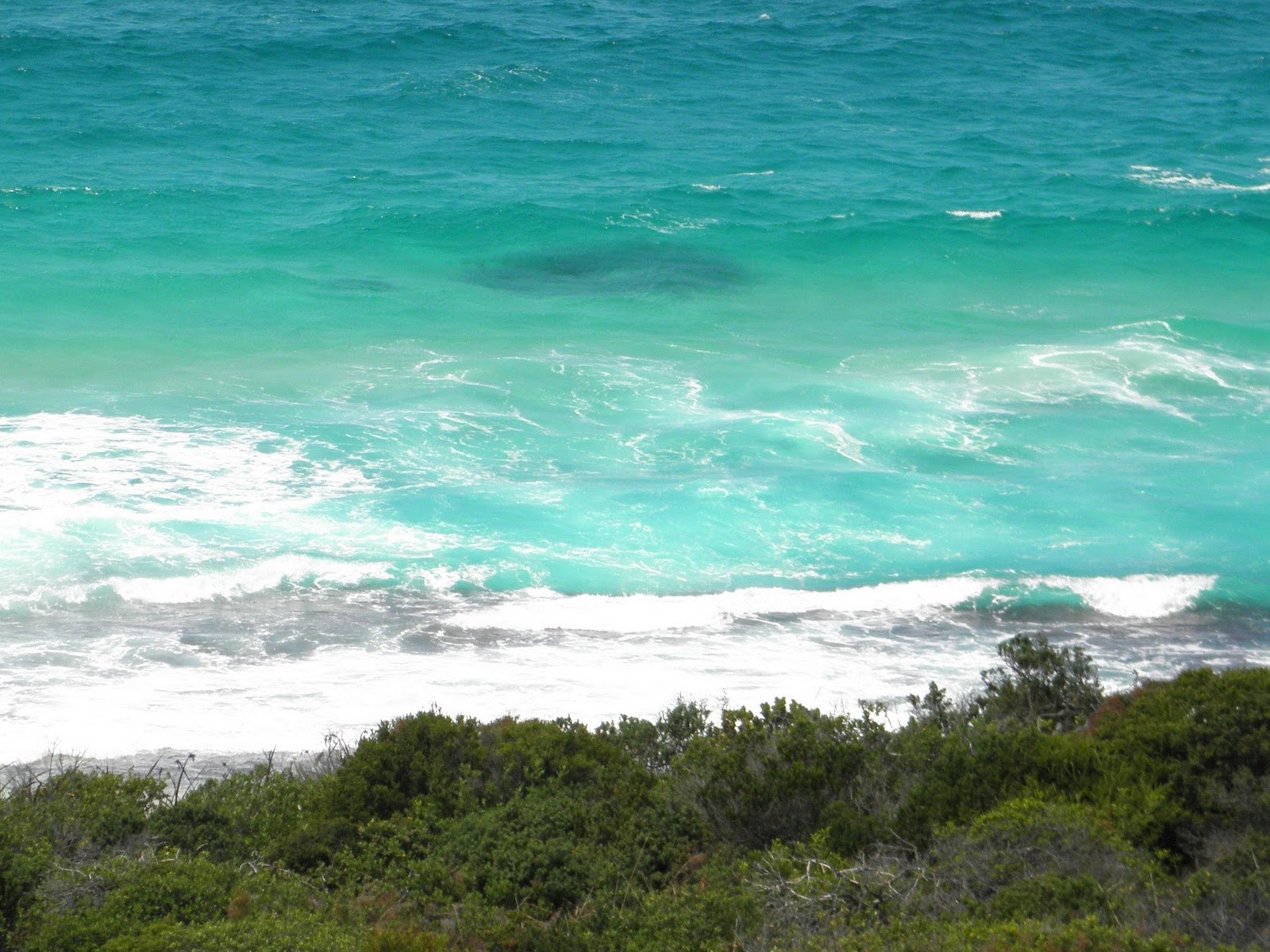
Trembling, hundreds of stairs later, I can still see the shoal of salmon. The white lace of a broken wave regularly obscures the black, drifting disc.
A dark shape moves in from the deep. The salmon circle into a solid grain, trying to become impenetrable.
They fail.
The dark shape breaks up the outer rim and wriggles lazily into the centre like the triumphant spermatozoa in that vital moment. The salmon fold away from the darkness, creating a lime green channel in its wake.

Thursday, December 2, 2010

Kooky Beauty's Dark Past


 No fisherman likes to lose good rope
to propellors running over their nets and buoys.
But the big problem with good rope lost
is that it will never break down and become one with the sea.
Good rope lost will cause problems
for generations of seals, sharks, dolphins and whales.

I made these baskets out of ropes and nets found at Peaceful Bay, Doubtful Island Bay,
Point King, Point Anne, Pelican Point, Princess Royal Harbour.
The green rope is longline, for attaching hooks to. I found it at Point Anne, where the whales come to play every year. Most of the grey and pink rope is from crayfish pots.


Sunday, November 21, 2010

Meat

Something that always amazes me when reading stories of shark attacks is that the survivors consistently and immediately go to the defence of their attacker. After facing annihilation by some 'other' than us, survivors of shark attacks seem to possess a compassion that goes beyond hunger and food and who belongs where.

Only recently when someone was attacked in metro waters, the public salivated for great white blood like Pavlov's Dog to the media bell. And boy, did they drool. I'm not mentioning names of the dead in this post but when a man was killed a decade ago during his extremely civilised morning dip at Cottesloe Beach, the footage of the guilty shark lounging around in the shallows just offshore ('I'm digesting, mate. Gimme a break will ya?') whipped up a lot of anger against the only minister who could authorise its execution. He was in a meeting apparently.

Cactus Beach, South Australia, is a roadhouse of the Southern Ocean for great white sharks. On one side of the peninsula, the locals from the windmill-strewn farms a bit north pull up their caravans and leave them there. At the jetty the plaque to a young boy killed by a shark is enshrined with a pair of goggles, flippers, seashells, red strands of sea weed, sea urchins. The shark net makes a triangle of the jetty and the shore. Despite how shallow and grotty the water is, swimming outside of that net induces certain insecurities and Does Not Feel Safe.

The other half of the peninsula is owned by a bloke called Ron. He bought the place in the 70's for a song after working as a brickie's labourer in Queensland to get the cash together. Ron's an Aquarian after my own heart. He's a bit of a hermit and became an environmentalist once he lived this patch of land for a while and saw its frailties. When I met him it was his birthday. He told me that not long after he bought the place, they staged the first RipCurl Classic there. Hundreds of people came, ripped up all the wood in the place, left toilet paper everywhere and trashed the sand hills. After that, he brought firewood in and started looking after the peninsula, acknowledging that surfers would always want to come visit one of the best breaks in Australia.

Two young surfers have died at Cactus by shark attack and this brings the peninsula toll up to three, plus the others we don't know about. On the headland looking over the Cactus main break is cemented another plaque and a familiar shrine to the Noah's supremacy in these parts. Like I said, no names, but some joker (probably a local with a sense of humour) had rubbed salt away from the brass, so that the only white, salt-stained letters left of the victim's name read 'Ron's Meat'.

Here is where I segue from the Southern Ocean to our northern waters, and from sharks to crocodiles. This is because I've just read Val Plumwood's story Being Prey and it reminded me to re examine my thoughts about shark attacks and the way us guys think we are somehow above the whole concept of being edible.

I've just discovered Plumwood and it feels like my discovery of the writer Michael King when I arrived in New Zealand. I encountered a writer whose work and life resonated so beautifully and perfectly and from whom I learnt from so quickly, only to realise they'd died a year or so before. Both of these revelations quite devastated me! Val Plumwood died in 2008. I hate to label her but she could be described in academic circles as an environmentalist/feminist/philosopher. She also was a relatively innocent party to a crocodile roll and that is the subject of her amazing essay Being Prey.

Plumwood's rendition of being dragged out of her canoe in a Northern Territory tributary by a hungry crocodile who wanted her for dinner is one of the most terrifying and lucid pieces of writing I have ever read. She was rolled, thinking she was going to die, not once but twice and then dragged out of the tree that she'd clung to when the crocodile tired, only to be grabbed and rolled under the water again.

As in the repetition of a nightmare, the horror of my first escape attempt was repeated. As I leaped in to the same branch, the crocodile seized me again, this time around the upper left thigh, and pulled me under. Like the others, the third death roll stopped, and we came up next to the sandpaper fig branch again. I was growing weaker but I could see the crocodile taking a long time to kill me this way ...

Val Plumwood's story is an amazing read but not because she describes the attack itself. In Being Prey, she applies her eco feminist philosopher's lens to the subject of whether or not humanity's supremacy automatically negates us from being the wagyu steak or sushi for other apex critters. And she is dogged in her dissection:

This denial that we ourselves are food for others is reflected in many aspects of our death and burial practices - the strong coffin, conveniently buried well below the level of soil fauna activity, and the slab over the grave to prevent any other thing from digging us up, keeps the Western human body from becoming food for other species. Horror movies and stories also reflect this deep seated dread of becoming food for other forms of life: Horror is the wormy corpse, vampires sucking blood and alien monsters eating humans.

Now I get why sea lice falling out of the nets and biting my toes upsets me so much.

Plumwood dragged herself up a slippery clay bank and started walking. She lay down bleeding in the floodplains. I hoped to pass out soon but consciousness persisted. It's a bastard, that consciousness. She was rescued many hours later and began the thirteen hour trip in the ambulance to Darwin.

My rescuers discussed going upriver the next day to shoot the crocodile. I spoke strongly against this plan: I was the intruder, and no good purpose could be served by random revenge.

When I talked about this across-the-board-attitude of victims towards their sharky attackers to a surfer friend, he said, "Well. Obviously. Most people who are attacked are people who hang out in the water. They are surfers, abalone divers, skin divers. They get it. They know the place belongs to the sharks and the fish. They know it doesn't belong to us."

And Plumwood saw in that universe of the crocodile roll that she had no more significance than any other edible being. She dismantled the 'monster, master narrative' in Being Prey. Her clarity and precision on the subject of how easy it is to be eaten, whether you are human or cow or rabbit or fish, is truly terrifying and kind of edifying all at once.


All italicised passages are from the article 'Being Prey' by Val Plumwood.
http://valplumwood.com/2008/03/08/being-prey/