Showing posts with label whaling. Show all posts

Wednesday, May 11, 2022

An Iteration of Moby Dick

I've been listening to Moby Dick, read by Phoebe Judge, during my long drives to the city and back. Judge also works the podcast Criminal and she's always blown me away with her quiet and polite laying out of an outlandish story. I'm not one to fall asleep to true crime podcasts and I still avoid Criminal as a go-to-sleep option - but I absolutely love her work.

Reading Moby Dick was a wade (sorry) for me. I tried it as a kid and then even as a groan up I could never get past the bit where Ahab held up St Elmo's fire and declared to all onboard that he was after the white whale and that was all there was for it. From there, on reading, the book seemed to descend into intricacies. Ishmael's voice was lost and even Queequeg's harpoon lost all its bearings.

What I discovered on listening to the reading recently was that this is one of the best books ever written on 1800s sea whaling. Melville's diversions into manila rope, the roles of seamen, of Pip offering up his very bones to Ahab, of boys black and white moved from ship to ship, of how to dismantle a whale at sea, of how to boil them down into barrels, of the cooper and carpenter, speak to a whaleman's experience in a time when they were three years at sea.

 It sounds macabre and it was so. Ahab's obsession with the white whale is but a sideline hustle in this book. It's like an instruction manual, a pretty accurate oral history and a call of warning to landlubbers before the great wars.

Vali Myers, Moby Dick, (1974)

Tuesday, May 19, 2020

The Sound of a Podcast


I'd almost forgotten what a ripping yarn this is. Rosemary Puddy who runs thebookpodcast has rerecorded my interview with her from a few years ago. Have a listen. It's great.
Here is the link: https://bit.ly/TBP019

Friday, April 13, 2018

Caldyanup Diaries # 6

When I was a kid growing up, they were still whaling in this town. The spotter pilot flew around looking and when he found a pod of whales, he'd radio the coordinates to the chasers. The fleet of old Norwegian ships would take off like a mob of Orcas on the hunt, a 'bone in their teeth' as the water curled away from the bow.

These days the spotter pilots fly around over country, not sea, looking for smoke during the wildfire season. When they see smoke they radio it in to the office and, depending on the situation, someone will send out a fleet of trucks or water bombers. 'Air attack' the bombers are called and useful in areas of impenetrable terrain.

The neighbouring district have been burning this week. The planned burns to reduce fuel loads in case of wildfires also rejuvenate the bush with new growth and smoke-germinated seeds. I was in the tower when three burns went up in quick succession - massive clouds of smoke rising high on the horizon fifty or sixty kilometres away. I listened to the chatter of the spotters from that district and the next one, as they called in smoke descriptions and coordinates. The spotter in my district radioed me to say those last two smokes I called in were private burns and there was No Attention Required.

Something I've noticed and wondered about: The spotters from the northern regions are no longer just calling in smoke. They are also calling in whales. Dead whales. The body of a humpback. A forgotten fin whale's carcass, from the mass stranding last week. Bush smoke and dead whales. There's something that feels apocalyptic about this juxtaposition. There's something in this picture, and I don't know what it is. All I know is that I've been obsessing over it all week.

Friday, August 29, 2014

The last whalers

This is so cool: it's a great article if you are interested in Australian whaling history, or even if you just want to read a ripping yarn full of home truths.
"He likened seeing into the eye of a live whale as coming before God."
The story of one of Albany's last whalers.

http://www.businessinsider.com.au/the-true-story-of-the-australian-whaling-ship-captain-who-turned-his-back-on-harpooning-2014-8

Kase Van Der Gaag. Portrait by Jonny Lewis. Copyright 2007

Saturday, August 23, 2014

Sarah's Sandwich Seminar


This map, taken from Lynette Russell's book Roving Mariners, is commonly called The Great Circle.  The map has been the best way for me to get my head around the movements of nineteenth century Southern Ocean sealers and whalers and is one of the images I'll be using as presenter at Thursday's Friends of UWA Sandwich Seminar:
'Reimagining the Breaksea Islanders. History and Fiction on the Eve of Colonisation'.

Before West Australia was colonised, a small community of seal hunters lived on the islands around Albany, where I live now. Their origins were diverse - African American, English, Maori and several men and women indigenous to Van Diemen's Land, New South Wales and South Australia.
Pigeon or Warroba, pictured below, was one such sealer.
(John Glover, 1833, Tasmanian Museum and Art Gallery, Hobart)

 
When Major Lockyer arrived on the Amity to found the settlement of King George Sound, he wrote that there had been 'some bad work done here' and within a fortnight he'd arrested several of the sealers with charges of murder and abduction.

Part of my PhD thesis is a fictional account of this snippet of history.  On Thursday, I'll talk history first, of the characters and events that I've found by delving into explorers' journals and reports. Then I'll go into the process of writing historical fiction based on these stories.

Here are the deets:
12.30 - 1.30 pm, August 28th
in the function room at UWA Albany.
Entry by donation.
You can ring 98 420850 to rsvp
You can bring yer lunch! And eat it too!

I hope to see any interested folk there.
Please be nice.
I'll be nervous.

Monday, June 2, 2014

On smoking whale vomit

"It's an undersea smell, they say, briny, like the inside of a sea shell and slightly fecal to begin with, studded with buttons of squid bones. It will mature to become grainy, musky and precious for its rarity. To verify, heat a needle above a flame and slide it into the waxen flesh. The smoke will be white and sublime in fragrance. Miraculous."


An old whaler placed a piece of ambergris in my palm the other day.
"How can you be sure?" I asked him.
"Ahh, oh, I dunno, mate. This old bloke just gave it to me and said it was ambergris."

It was quite black, looked like a meteorite, felt waxy to the touch and weighed nothing. I held it in my hand and sniffed at it. It didn't smell like much. I wondered about the whale who'd once carried the lump of ebony stuff in its stomach through several oceans, hemispheres, for decades. How did 'this old bloke' get hold of it? Did he find it on a beach after a whale had vomited it up? Did he dive into the hot belly of a slaughtered whale and dig it out? Did someone sell it to him in a bar or a Nantucket souvenir shop?

"Let's sink a hot needle into it and see what it smells like," I said to the whaler. So we went from the carefully-curated museum in his lounge room, up the hallway, to his kitchen table where a forest of Worcester, Tomato and Barbeque sauce bottles stood over an understory of chaotic ashtrays, empty coffee cups and stacks of the old whalechasers' log books.

"I've got some needles here somewhere," he rummaged through the kitchenette, brought out a biscuit tin and reefed open the lid. He started emptying a whole sewing kit onto the table; a quick unpick, cotton reels and packs of pins and sewing needles. "Whaddaya reckon? The quick unpick?"
"Just give me a decent needle that won't burn my fingers."
He eased an upholstery needle from its cardboard sheath and handed it to me. I flicked the cigarette lighter and held the flame to the metal. He placed the ambergris on the plastic, flowered tablecloth and I plunged the red hot needle into the lump.

Both of us leaned in to get a whiff of the white smoke that plumed from the needle and then reeled away coughing. It was a bit like smoking hash from heated-up bread knives except this delivery system was via our nostrils. Mick must have got more than me because his coughing fit lasted several minutes (later he blamed it on a lifetime of White Ox), whereas I was merely bemused on how awful the revered, mythical ambergris actually smelt.
"It smells like shit burning," I said.
"It's really bloody stinky mate," He said once he'd drunk a cupful of water from the kitchen sink and recovered.

And it was. But there was something else beneath it; something sublime and utterly inexplicable.
Anyone who has read the perfect novel that is Jitterbug Perfume will know that under any fecal, nasty smell lies something more beautiful, something that goes straight to our old lizardy selves. Sure it smelt like burning shit but it also carried the very essence of sex, death and the nature of humanity. Both of us agreed about this. (This is coming from two smokers with no knowledge of perfumery.)
It was there, it was amazing and we smoked it.

Saturday, May 24, 2014

"They died hard"

Kase (I've always known him as 'Kasey' but apparently his first name is spelled Kees or Cees) Van der Gaag died this week. He was one of the last of the whalers in my town; a man who has in his own quiet way proved instrumental in the cultural shift from whale-killing to whale-watching in Albany. He was born in the northern hemisphere but chose the  Antipodes to live out the rest of his life.

Occasionally when I visited old whalers to interview them or say hello, Kase would drop by with a bottle of whiskey. He was a dignified man with a blue-eyed, romantic and practical demeanour that made me feel comfortable as soon as I met him. He reminded me of my father. He had the most excellent manners. He summed people up quickly. He sparkled with a gentle, old knowledge and something of the new world too. The title of my post tonight is a reference to something he said during his whaling days .. he was just a beautiful renaissance man, really.
He hated seeing those whales die.

This week, one of the world's great storytellers was offered up to our earth. When I read in the local paper that he'd gone... for a quiet still  moment, part of my life broke away. I knew that another library had burned down and still I drifted happily out to sea with him ...


Chris Pash, who has been following this story since the 1970s  has written an obituary to Kase here:


Monday, March 31, 2014

Huge. Bigger than a whale.

Apparently Japan's whaling regime in the Southern Ocean has been deemed by the International Court of Justice to be unscientific.
Now who would have thunk it?

I've had plenty of arguments with Old Salt about modern day whaling in the Antarctic, but my final answer came when he tried to explain that it was a 'cultural thing'.
"What. With diesel powered gunboats? Thousands of nautical miles from their traditional hunting grounds?"

It's rare for 'cultural things' to dress up in a sciencie frock to justify a commercial industry, but this particular frock has been doing the hokey pokey in the Australian Whale Sanctuary and getting away with it for ages*. So it was with a glad heart that I learned the ICJ has ruled that Japan's whaling program over the last decade or so has been carried out for commercial purposes. Not scientific ones. Therefore, the court has ruled, no future permits will be issued for the Japanese to hunt whales in the Southern Ocean. There is to be no appeal.

Here's the news: http://www.abc.net.au/news/2014-03-31/ijc-japan-whaling-southern-ocean-scientific-research/5357416

*Did you see what I did there? The shittiest sentence ever, dressed up in a frock with fractals. And it has whales in it.

Thursday, March 13, 2014

Roving the Southern Ocean

This is a great interview. Russell talks about Aboriginal whalers and sealers on the south coast of Australia.

"Aboriginal men and women were an active part of the sealing and whaling industries in the southern oceans in the nineteenth century. Even though the historical record is incomplete, Professor Lynette Russell has mined ships' records and sailor's journals to find individual stories of roving mariners."


Go here to download the post:  http://www.abc.net.au/radionational/programs/awaye/roving-mariners/5009868

Friday, January 3, 2014

Bittersweet

She was a decrepit, failed restaurant venture, tethered in disgrace at the end of the Deepie but that night was the pinnacle of the old whalechaser’s career as an eatery.
 

We weren’t supposed to be there, something about asbestos and public liability but my father was the caretaker, so ... there we were.
 

Candles glowed in the jarrah-lined innards and a strange, longhaired man played guitar on the iron stairs. Cast iron cauldrons of dahl and rice sat steaming on tables beside huge mounds of baked salmon covered in lemon and strips of bacon.
 

Dad wanted to introduce his daughters to the woman he would marry. Together, they’d put on a feast.
 

My guests; my silent beau and the ancient, drunken Scot, were the escape plan if things got too strange.
 

We slid into red velvet booths, shared green ginger wine, peeled away silvery salmon skin, and broke flakes of juicy flesh from the bone with our fingers. The taste of bittersweet iron made my teeth hurt.
 

When Hector finally succumbed to his Drambuie on the booth seat, (crumpled kilt, legs askew, it was not pretty) Julian and I climbed back out into the clean night air and stood together on deck. 

Under the full moon, yachts flew like white moths across the harbour on their annual autumn migration.

Wednesday, September 18, 2013

He saw a man swallowed by a whale

He saw two large Sperm Whale three miles away
He saw two boats launched
He saw them them spear the fish
He saw the second boat upset by the lash of a whale's tale
He saw the men thrown into the sea.
He saw a man be drowned and another,
James Bartley, be disappeared, and not to be found.

He saw the whale lying by the ship's side
He saw the crew busy with axes and spades
He saw them removing the blubber
He saw them make the tackle to its stomache
He saw the sailors start
When they saw Bartley writhing inside.

He saw them lay Bartley out upon the deck
He saw them treat him to a bath of salt water
He saw Bartley rise, raving
He saw him rave for half a moon
He saw the man who was swallowed by a whale
and resumed his duties after twenty one days.

From Ambrose John Wilson, The Sign of the Prophet Jonah and its Modern Confirmation, vol. 25, Princeton Theological Review, 1927.

Friday, April 12, 2013

Yesterday: Cape Riche to Albany

 At dawn, dolphins followed K as he came ashore to pick us up.

 Cheyne Island at Cape Riche. That tiny knob on the left side of the island is a stone lookout from the bay whaling days.

 Haul Off Rock 

Bald Island

 Bald Rocky Islands. Actually I'm not sure what they are called - just west of Bald Island. They are very bald and very rocky.


 Autopilot makes time for conversations and fishing.

Waychinicup.
"Just imagine if you came across that channel into the inlet after days and days of rough seas. Imagine if you discovered Waychinicup."
K's son laughed. "Yeah it would be a beautiful thing. But you'd never want to get close enough in rough seas."

 Cape Vancouver

Cape Vancouver and Mt Gardner.

 The most impressive Rock Dundar


 Breaksea and Michaelmas Island, left and right.

K was a happy man to sail into town, two years after he sailed away.

                                                Green Island, Oyster Harbour. Nearly home.

Apologies for the standard of photography here - and some excuses. The light was beautiful and misty from dawn to dusk, the hills and island shrouded in salt spray. I have a feeling my phone camera was shrouded in mist too.

Tuesday, February 12, 2013

Just Wow

The Endurance getting slowly crushed by ice

Last night I read an article by Jo Lennan in The Monthly. Here is an excerpt:

"Wonderful, aren't they?" Jarvis said as he donned the mitts. "They look just like beavers. There are lots of jokes, obviously." The rugged 46 year old slipped the lanyard over his head. "It's like a kid when you don't want him to lose his gloves - but you cannot afford to lose your gloves. You put one down, it gets blown away and you lose your fingers."

A composite photograph and drawing of the Endurance crew's whaleboat hut
on Elephant Island
He was preparing for a journey that is now underway: in mid January, Jarvis and a five man crew set sail from Elephant Island, off the Antarctic coast. They aim to re-enact Ernest Shackleton's 1916 sea-and-land crossing to a whaling station on the island of South Georgia - and, along the way, to photograph signs of climate change.

Sir Ernest Shackleton

To keep things interesting, they've gone with vintage gear, right down to their replica seven metre whaler - "really a hopeless boat." The Monthly, February, 2013, p.13.


A drawing of the whaleboat James Caird sailing from Elephant Island
to South Georgia to raise the alarm of the Endurance sinking.

Shackleton and crew arriving at South Georgia

"The cliffs we descended whilst crossing the island"
South Georgia.

The Endurance's journey in red.
The James Caird in blue.


This morning I woke up to Fran Kelly on Radio National interviewing Tim  Jarvis, who has just made it, along with Barry Grey, from Elephant Island via the huge seas of the Southern Ocean to South Georgia and then overland to that island's whaling station. They achieved this amazing feat with much the same equipment as Shackleton's crew: hobnail boots, sleeping bags stitched from reindeer hides, beaver skin mitts, a single wooden adze for a mountain climbing pick and a wooden boat whose maximum speed is around two knots.

I've rarely heard Fran Kelly, the cool-as-a-cucumber political reporter, sound so excited.
Here is a link to her interview. It's great.
http://www.abc.net.au/radionational/programs/breakfast/adventurer-replicates-famous-antarctic-exhibition/4513486


And here is a link to The Shackleton Epic's website: http://shackletonepic.com/
Colour images: Adelaide Now and The Australian.

Monday, December 31, 2012

Sunday, December 30, 2012

Shipwrecked Picnic

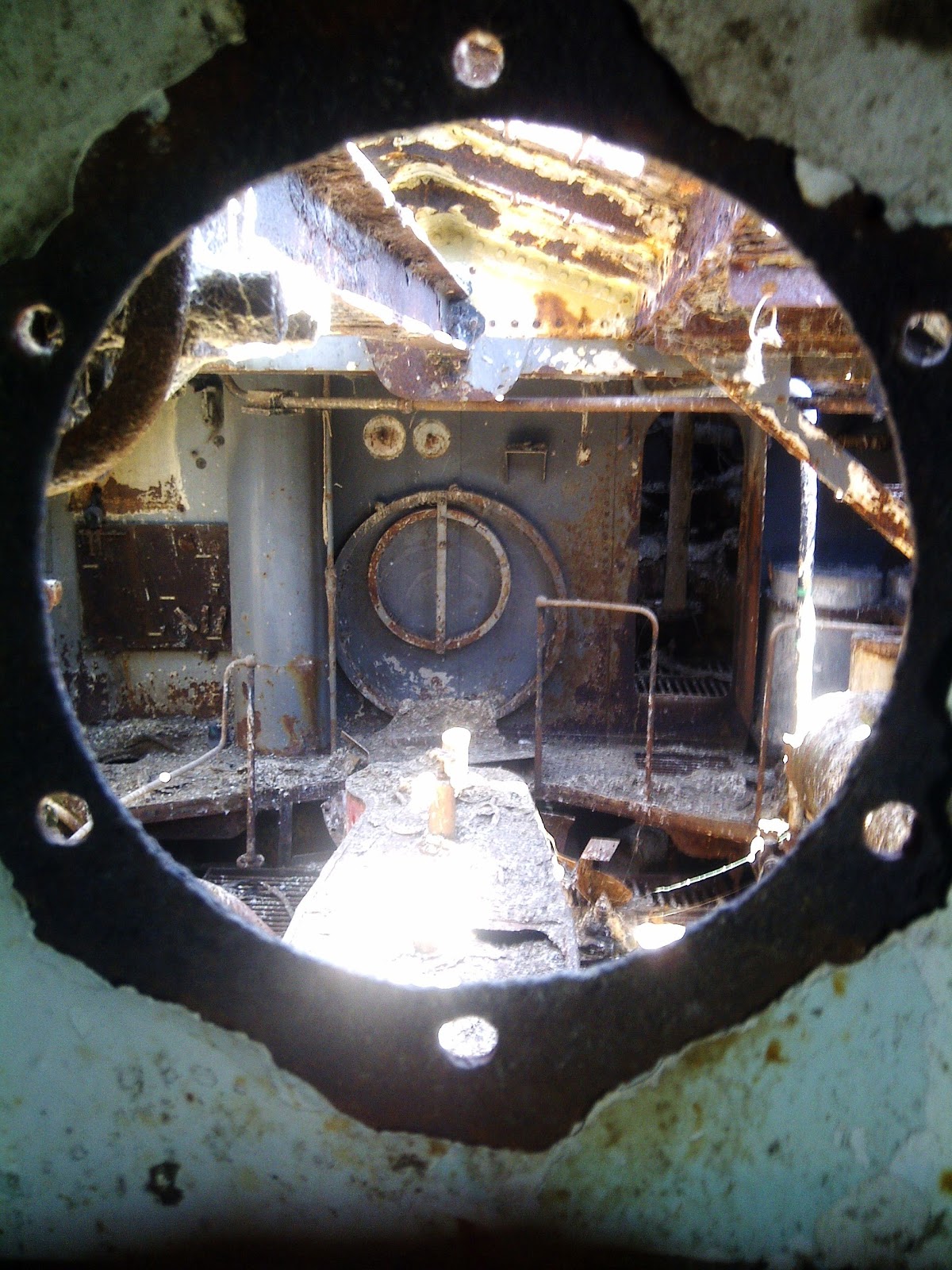
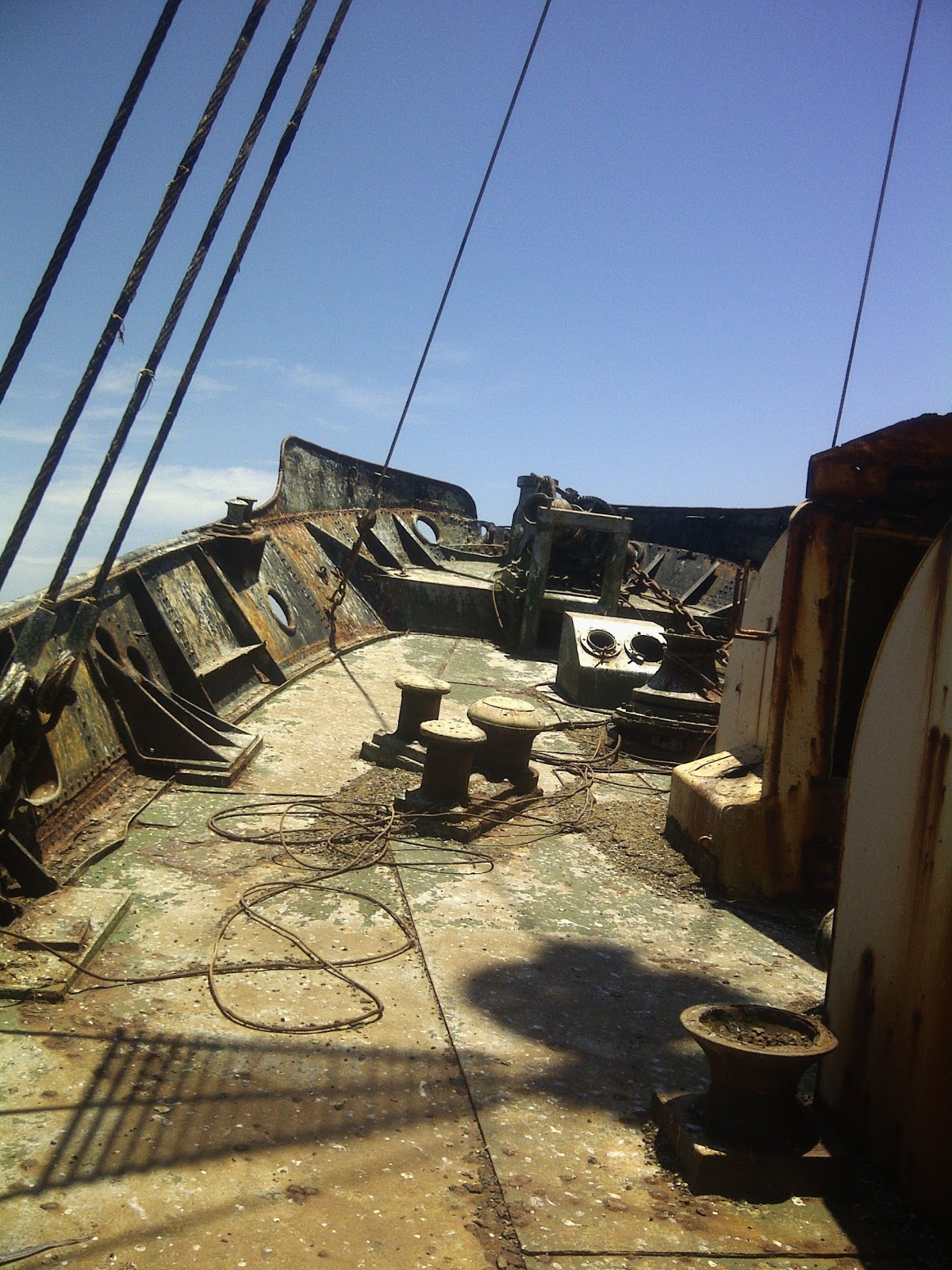
 Yesterday, myself, Dad and some sisters borrowed the boat and took off across the harbour to visit the old whalechaser. These days the ship is tenement housing for pigeons and the smell of guano is almost overwhelming. The picture above is of the engine room. Check out those piston rings.
Below: Cookie being a fruit, looking into the wheelhouse.


The crows nest. "One day soon, that mast'll come down," Dad said. He used to live on this ship for a while as a caretaker, a year or so before it went onto the rocks at the deep water jetty.

 The foredeck with the mounting for the harpoon up at the bow.


Yes! Mussels! Dad does cool stuff like this. He brought out a little cooker and a pot and we ate the mussels we gathered from the sides of the whalechaser, for lunch.


Thursday, October 4, 2012

Getting Bailey Down in the Lookout

Old Salt was in his caravan, reading the paper and eating lollies, waiting out the day until we could set nets again. I asked him if I can take the dinghy out to the sand bar. I wanted to go exploring past Cag's Camp, around the corner to Groper Bluff. And could I take the dog too? He nodded, twice.

The real reason for my coastal hankering that day was not to explore but get a handle on how to write Samuel Bailey kidnapping a seven year old girl off the beach on this same stretch of coast. I'd been intending to do it for weeks and kept putting it off. A day in Bailey's company is no fun. Writing in the quiet blue room can be an insular experience and invoking Bailey just makes me squirm; the twisted shit he'd done. (In case you have not been following this tale, Bailey and the little girl are real people from the 1820s.) When writing Bailey, I'll sometimes go across the road to the pub and buy myself a bottle of wine just to get through it.

After anchoring the boat in the soft sand of the bar, taking care to shelter where she wouldn't blow onto the sand and get stuck (a real bastard when I'm the only one to push off - the dog is never any help), I headed for the gathering of salmon shacks perched above the sand dunes. Wandering along the track to Groper Bluff, I was thinking about snakes and my bare feet and the flowers and saw those amazing mushrooms that bounced out of the barren soil like optimistic aliens.
And then, I came across the whalers lookout ...


Oh boy. Was this one of Cairn Man's depredations? The structure looked 'worked on' ...too tidy for a 19th century job. I really hoped it wasn't Cairn Man. In the end, I deduced that it was an original that had been fixed up a bit. There is a whalers lookout on Cheyne Island, adjacent to Cape Riche, which is very similar in structure, although a little bit more ragged. Stormboy found it when I dropped him off there a few years ago.
"Mum, I'm feeling really sick ..."
"We've still gotta pick these nets up."
"Get me off this boat! I wanna go home."
"How about I drop you on a deserted island for an hour?"
He nods vigorously, "Please Mum, please."

(Call me a bad mother if you want but I still find it hilarious that my son preferred being dropped off on an island, all alone, as a ten year old, rather than hang out with me, providing berley for whiting.)


Shore based whaling east of Albany predated the colonial era and many of the whalers were Americans or from the Eastern states. They chose beaches like this one to flense the whales, setting up their trypots and reducing the leviathans down to mere barrels of oil and bones.


I sat inside the shelter on a flat stone that some kind soul had prepared earlier. Suddenly, I was warm, the sou-westerly at my back. Of course it was a whalers lookout. Sou westers are the season for whales. The utilitarian nature of the structure all made sense. I looked out to sea and thought a bit about what it would have been like.
Samuel Bailey and the little girl just swam straight into my head. I wrote down the whole scene as fast as I could, before the march flies found me.