Showing posts with label local subversives. Show all posts

Friday, May 9, 2025

Liz and the Tingles

The generator is whirring outside tonight. I say whirring, maybe it is thumping. Anyway, the generator is a presence, a petrol-induced entity who keeps the lights and internet on. My batteries connected to the solar panels are giving me ambivalent signals right now. Living off grid is a constant mind-state of thinking about power sources.

Last week a young woman contacted me. 'Hi Sarah, I'd like to interview you about your part in the Women's Work project. Could we set up a time for me to film you talking about this project?' 

As always, I was driving between towns. Someone once told me I have a house in Gemini, which means I live in two houses and this is so true. I replied, stuck in road works world between two towns, 'Coming into town. Can we meet at Lawley Park?'

There were several vehicles at Lawley Park when I turned up. It was lunch time, so some council workers stretched by their truck, a stray Winnebago lurched between the big colonial trees and there was that guy in a lime green Holden commodore. The driver of a crimson people mover looked like she just needed to get away from her kids.

Rachel from the television news network got out of her white SUV and started setting up tripods, checking her camera and testing the audio. From my old lady point of view, she looked like she was about 11 but she was actually a pretty competent woman in her 20s. She interviewed me for about fifteen minutes, went back to work, did the editing and production work herself and her story was on the news by 5.30 pm.

I'm bringing up this scene because I have spent several months creating a simple audio visual story to contribute to the Women in Media, Wimmin's Work project. The State Library asked me to contribute a story and I was like, 'Of course, yes! I can do audio work.'  (ummm). After months of quite intense sessions on my own with head phones and still learning the lingo, I came up with this:


I mean - it took me months! And Rachel from Channel 7 did much the same thing in about three hours. I'm now in awe of people who can put together a story so fast. Anyway ... enjoy my foray into AV. It's been a trip. If you would like to see other stories from the same project, go here: 

https://slwa.wa.gov.au/wimminswork

Sunday, March 3, 2024

Aghh!


For those (two) of you who are interested in the outcomes of my investigation into the Youngs Siding white ant signs, here is an update.

No it wasn't sign posts to a bush doof. Apparently it's about a long standing feud between tow boat operators on the inlet and this is the latest iteration in a thirty year war. It's odd that this battle erupted at such a quiet inlet but there you go. 

The Broke Inlet Towing Company has long held the rights to towing all broken boats to shore. That's Yowie CEO. He's the guy. He'll save you and salvage your boat. Unfortunately, Yowie was not present recently when a boatsman in distress asked another party to tow him into shore. Yowie reflected that he felt undercut and white-anted by this rogue towing company called the Youngs Siding White Ant Recovery and Salvage..

This problem all started with the Black Pig Racing Club in the 1990s and an annual race that should've been on January 1st but usually ended up being contested somewhere in September, as no one could get their shit together before then. Are you still with me? Good. 

In 1998, the Blacker family bought a 50 horsepower jet boat (Holden red motor, go the Blackers! Fuck I love that sound) but everyone else thought this was rather bad form because they were racing against the Blackers in dinghies with 25 or 15HP two strokes that sounded suspiciously like lawn mowers. That's the moment when the bad blood came in.

So ... the Blackers towing a boat out of the inlet and Yowie from the Broke Inlet Towing Company's feelings about that particular incident have rejuvenated the old war over the last few weeks. Those white ant signs are a bold move from the Blackers, and a raised middle finger to the status towing quo.

How are we going here? When I tried to explain the saga to my son, Stormboy replied, 'I'm not sure how to respond to that one but someone has dedicated a lot of time to those signs.'

Yes, there has been some effort and thought put in. I find the whole episode quite beautiful.


Friday, December 8, 2023

Past tense

Years ago I wrote a story on A WineDark Sea called 'Can't kill him with an axe'. It was an account of the times I'd nearly killed Old Salt on his fishing boat. He'd previously had heart surgery ('they put a bit of pig in me!'), licked asbestos as a kid because he liked the tingling feeling on his tongue, had an affinity for battery acid and thought electrocution was a fine remedy for Ross River Virus.

Bill died on Monday. It's a weird feeling. When a close friend is dying, people ask if I want to visit them but I'm already there, somehow. Several hundreds of kilometres apart and I'm with them. I don't really know how to explain this. Despite this feeling, when Nga told me on Sunday that he was now on morphine, I'd said, 'Yeah, I'll ring him in the morning.' He sounded fine on Friday when he took of his oxygen mask to chat. Fine.

He was my mentor and teacher. He taught me everything about what it is to be on a boat, how to follow the channel markers home to port in the middle of the night. That was one of his first lessons as we motored home from Michaelmas Island. He taught me about family, about how fish think and how to tie knots (still terrible at that).

He seemed incombustible, unkillable. An incorrigible white man with a stout sense of right and wrong, a strong interest in his family's history of fishing the Great Southern inlets. He never gave up. So Bill, the star of Salt Story is gone. Bizarrely and so bloody banal for someone who always sailed too close to the wind, he copped covid at a funeral a few weeks ago. On Monday, we'll go to his.


Friday, July 7, 2023

Ginger Sow

 I've just installed the trail camera at a spot on the track where I've seen the cutest feral pig three times over the last week. She is a black pig with a ginger stripe going right around her middle and a row of suckling teats on her underside.

At about the same time I saw her, Jimmy turned up at my house. He's a handsome young man with a disorganised gait.  'Hi Sarah,' Jimmy threw out his hand. 'Look, my car ran out of petrol halfway along the track. Could you give me a lift back there? I have some fuel in the shed.'

The last time I saw Jimmy, he sought my help after he'd bogged his Dad's tractor out in the middle of the inlet. Yes, you read that right. Bogged his Dad's tractor in the middle of the inlet. 'What were you doing?' I asked him back then. 'I was setting nets but then the tractor fell in a swan hole.' 'Setting net from a fucking tractor? Have you not heard of a boat?' I decided to give it a red hot hot go anyway to break the monotony. Jimmy and I got down to the shore, after sourcing several hundred metres of snap straps and rope. The tractor sat out in the inlet like a kinda sad, defeated island.

The operation was an abject failure with me skidding all over the beach on the end of a tow rope, threatening to tear the chassis out of my car at sunset. The next day a few more 4WDs turned up and towed the tractor out. Jimmy was instructed by his family to never use the tractor again.

So when Jimmy turned up the other day, I was grateful for this lesser chassis-destroying request. We drove up the track to deliver petrol to his car. At the point where the track turns into white, slidey clay during rain, I said, 'I've seen a pig around this spot, every other day for the last week.'

Jimmy nodded and said, 'Yeah, last night as I was walking in, I smelt something, like an animal was living around here.' When we got to his car, standing in the middle of the road, he hauled his fuel cans off the back of my ute and got busy.

As I drove home behind Jimmy, I kept thinking of this mother pig, of where she had stashed her piglets, and also of Jimmy's midnight walk along the track. So today, I put a camera trap in the spot where the track get slidey and made of white clay. I'd love to see what goes on there at night.


Monday, May 29, 2023

Tank? Empty

The state premier of Western Australia has just resigned, citing exhaustion. He said his portfolio as premier and treasurer will finish by the end of this week. To paraphrase the words of Aotearoa's  (New Zealand's) former Prime Minister Jacinda Adern, his tank is empty. He's done. He's out.

State Premier Mark McGowan closed off the state from the rest of the country in the early days of the Covid pandemic and it afforded us about 18 months of relative normaility. This sounds weird, I know. But we didn't have to endure many local lockdowns - because the state was also shut off from the world. It was really cool. There was no Covid here. We could move around as much as we wanted to. Nobody got sick from Covid in the early days because it just simply didn't exist here. He did that.

When the federal election happened last year, Labor won on a landslide, mainly on the back of various Labor politicians such as McGowan, who'd fought so hard for public health. His decisions were often unpopular. He'd declared opening borders by a certain date and then abruptly closed the borders again. We in Western Australia were called the 'hermit kingdom' and 'cave dwellers' by right wing pollies and journalists in the Eastern states, merely for being anti Covid. Our geographical advantage was obvs.

So the Premier gave a press conference today, stating his resignation. He didn't cry. His wife looked stoked (Oh boy I can only imagine) and he then bowed out with not a Royal Commission or ICAC review ahead of him.

Good job Mark and I thank you for your service.

Sunday, April 30, 2023

Pistols at Noon

There's a hut in the bush close to my place. It's called Old Smoky because the fireplace doesn't work that well. Old Smoky is on the same property as mine. It's clad in blue asbestos and corrugated iron and the floorboards are made of jarrah timbers. The windows are not glass but plastic blinds. There is no toilet and only the remains of a gas shower.

The whole while I've lived here, a man by the name of Wally stays in Old Smoky on occasion. He always comes over to say hi and let me know that he's in the vicinity. After that, we leave each other alone. He walks out a mullet net in the evenings and sometimes brings me some fillets. He'll bring a load of split jarrah for firewood and stash it in the old rainwater tank, set sideways, like another hut or shelter but to keep warmth and cooking fuel dry, not people..

The commercial fishermen came one year and moved into Old Smoky. Chicky and Brownie found Old Smoky a welcome refuge from camping on beaches in tents. The hut is on private property but they just moved in anyway. I go visit them and sometimes partake in their moonshine. It's rough liquor and the air in the hut is always smoky and close. Brownie chainsmokes tailormades and Chicky is the one who makes the liquor. Chicky and Brownie sleep on swags laid across iron bedstands.

Last year, another man came to stay in Old Smoky. He was confused and alone, a dislocated product of divorce, a lack of meds and the pandemic. I know he'll hate me for saying this, but that is what I saw. He gave me some soap and incense which was a nice gist and told me he was moving into the hut.

So while I was used to Wally and his respectful ways around Old smoky and while I was used to the fishermen turning up when the inlet opened for netting seaon, this Bear Grylls character was a new one. He was trying to do a Broke Inlet version of the TV series Alone except that it also involved asking me to charge his mobile phone on my solar system's inverter and lend him twenty bucks when he ran out of wine.

So. That was a bit weird and I expressed as much to Wally next time he turned up. He was kind of incensed. Not about me having an odd neighbour but that someone was moving into his hut. It's not Wally's hut but Wally was still pissed. After three weeks Bear Grylls gave up on his plan of living off the land and moved back to Albany. On my trips to the city I still occasionally see him walking up the main street in his camo gear and DriZaBone..

Then the fishermen moved in again. They burnt all of Wally's split jarrah, that load of wood Wally had so covetously collected and stashed. They burnt it in the dodgey fireplace Old Smoky is famous for, over the whole netting season. Wally came back in the spring to find all his firewood gone. So now was he doubly pissed. Not only have people been using his hut (which he does not own) but they've taken all of his fucking firewood! (Fair call)

Wally fortifies the door and puts a padlock on Old Smoky. He plants some tomatos, chillies and a lemon tree over the mullet frames he's buried. This is a territorial war,verified by vegetables. I know I've gone from past tense to present tense but shit is getting real now folks. Bear with me.

Today, the fishermen returned and Wally was waiting for them. He knew they'd be here on the first of May and he moved his whole famility into Old Smoky for two weeks. Brownie and Chicky came up from the beach to see me, after they'd launched the boat and moored it in the inlet. 'Wally's in Old Smoky?' Chicky asked me.

'Yes,' I said. 'Would you like to borrow my tent?'


Wednesday, March 8, 2023

Grader Driver

Today I'm going to talk about grader drivers. Grader drivers hold a large part of my mind's life. Anyone who has ever lived down a gravel track will know what I mean. 

The track to my house is ten gravel kilometres long, so six miles in the euro lingo. I travel this track every day, have done for the last seven years and sometimes it's just the fucking worst. It's my car that I feel most for, but secondly my mental health. Sometimes the corrugations and pot holes get so bad that I am crying by nearing home, knowing I'm contributing to the condition of the track as much as suffering those bastardy corrugations, that I'll pay with both travel and maintenance. It gets worse. Every year of driving the track, I pay for broken radiator mounts (three times now), new tyres, shock absorbers and all the shit I've lost off the back of the ute on the way.

Anyway, the grader driver came today. The grader driver is like this kinda Zen doctor who puts everything right with the world. That's how I see him. He grades the road so smooth and flawless that people like me fall at his feet in wonder and worship.

Grader drivers work alone in often lonely landscapes. They grade a road and may never know who silently thanks them for the work they do. They are like garbage collectors or nurses.

Today I pulled up beside the grader. It's a huge machine and he kept the engine running as I spoke. 'Thank you!' I yelled. ''I love grader drivers.' 

I couldn't hear his reply over the grader but he was smiling and giving me a thumbs up. The rest of the track felt like I was floating. So smooth. This guy?

 He should be paid like a CEO.

Friday, February 24, 2023

Top Gun Warlitch

I've been logging wedgetail eagle visits to the granites of the tower lately. Writing down the date, time and number of eagles. Most days a young male eagle visits, cruises around the tower and then flies away across forest country. He's my regular, bright colours, patches of white amongst the striking pattern across his wings. Sometimes in the tower, I'll feel a shadow fall across the summit and there he is. Today was an extended visit. It was thrilling! Sometimes I thought he'd land on the mountain in front of me. Later, two of his siblings hit the skies above me, sending the other birds up to harass them.


Monday, January 30, 2023

Latest fake news on the quokka scenario

 Apparently, the Thylacine sign that appeared just up from my driveway in 2020 was a response to the Quokka sign put up days before. The reasoning was that no one had seen a quokka on this road for more than forty years - but no one had seen a Thylacine either - so the best minds at the inlet decided that the Quokkas must have killed all the Thylacines and then erected the Quokka sign in a kind of passive aggressive tactical maneuver. In an epic act of resistance, locals decided to write an email to the council who eventually produced another sign.


Here is my initial investigative report released two and two thirds years ago. I'm happy to report that the Thylacine sign challenged Quokkas, and that break and enters by Quokkas at the inlet halved by at least a quarter. This was a massive success in lawn order.

Until yesterday.

Yesterday, I saw a Quokka crossing the track as I was driving to work. It was very close to my house. I know they are dangerous when cornered, so I didn't stop the car and anyway, I wasn't wearing any PPE.

This sighting of a killer, delinquent Quokka on the track was interesting. BUT on my way home from work, I noticed that the Thylacine sign was missing. Someone had removed the sign, post and all. IS THIS A COINCIDENCE??? I think not.


Stay tuned folks for further updates. Next week I interview Doctor Runnell McSquarePoo, an expert on the sinister habits of all maligned marsupials.

Fuck I've gotta start a true crime podcast *mutters* onto something here

Saturday, November 26, 2022

Weeding out the diesel

Just been reading Don Watson's Watsonia*, a collection of his essays and articles over a lifetime. Watson wrote, among other things, speeches for the former Prime Minister and Hawke-era treasurer Paul Keating. Not sure, you can fact check me on this, but I reckon he wrote the Redfern Speech, nearly approaching its 30th anniversary and a pivotal moment in our nation's history. Below is a shortened version.

Watson has an interesting take on writing political speeches, saying that his words belonged to the politician who spoke them, not to those who wrote them. I understand this sentiment as - speech writers are given talking points and then work those points into something beautiful and stirring. Those words no longer belong to the writer. It all sounds a bit meta but ask any writer if their words belong to them once their books go out into the world.

Anyway, folded into his book on topics so varied as the impotent decency of John Hewson, Australia's problematic relationship with Indonesia re East Timor, cricket and the politics of class envy, was a chapter on marijuana. So bear with me now as I head from international politics, the floating of the oz dollar and pathos of child jockeys, to the most illustrious vocation of growing weed.

'Seasonally Adjusted' begins with "So it is autumn. To put us beyond the claws (clause?) of winter, we should be storing up and making mulch." Yes, he's talking harvest time. "Turn the apples into cider. Stew those stone fruits." This story is a hymn to the gardener. "Gardening increases the level of personal debt,' he writes. "If you have a garden, you do not need any other worries.'

One may garden in Australia to their heart's content, he continues. We may grow wolfhounds or fairies. We may grow bank robbers or aphids or even the ladybirds to feast upon them. We may grow colonisation, 'We may throw clods, spit upon and barbecue animals. There is nothing to stop us indulging in idolatry ... we may sunbake, smoke and use a chainsaw.'

'No one will dob you in for dreaming here, but if you grow marijuana, they will.'

If you grow weed in your backyard, you'll get dobbed in, writes Watson. Coppers will leap over your camellias to get to the weed after the neighbour has done an 'Alert but not Alarmed' call. It's like the worst crime possible. Then the police will uproot all the offending plants and take them away in evidence bags to burn on a bonfire of righteousness ... 'well most of it anyway,' Watson writes, in a tongue in cheek reference to police unofficially taxing the revenue.

This "most of it anyway" reminded me of an incident in our great south coast about thirty years ago. After the raid of a massive bush crop, the local police took the plants to the local tip, poured diesel over it, lit a match and left. It didn't burn.

Word went out that there was heaps of dope at the rubbish dump. In those days, the dumps were not continually monitored by people so it was free weed for all. To this day there are stubby holders commemorating the event. All I can remember was the amount of hash I smoked during that time. It always smelled vaguely of diesel.

At around the same time, the Prime Minister was giving his Redfern speech. I dunno how this all connects up. It probably doesn't, except for Don Watson. Please forgive me for attaching the greatest speech in post colonial history to that time when weed was free thanks to the WA Police.

https://www.theguardian.com/books/2019/jun/02/looking-into-the-abyss-don-watson-on-facing-his-mortality

* love this re context. Watsonia is the worst weed ever!


Wednesday, August 10, 2022

That's a Bravo 111

Smoke descriptions are one of the most important pieces of information that I use when working the fire season in the south west of Western Australia. From my lookout, I describe what the smoke is doing. This indicates what kind of plant matter the fire is burning (colour) how the fire is behaving (standing up, drifting etc) and what the fire is about to do (heavy, billowing). Smoke behaviour is communicated, in what may seem an arcane code, back to the office, where everyone there has to decide what to do next. 'Send out a truck? Several trucks? Water bombers?' For about four months of the year I sit and watch for smokes rising suddenly from forest, farms and suburbia. 

Anyway, my new neighbour, this adventure guy in camo escaping a bad marriage and/or something something is still ensconced in Old Smokey. Tonight I drove in from the city. He'd removed the branches that fell in the last storm on the driveway and set them to one side. Careful like. I'm still feeling cranky at Struth who let him stay at Old Smokey but in the mornings I'm hearing these cheery conversations which makes me think Camo Man is now Struth's deckie.

A Bravo one one one filed from the hut's chimney. Blue. Fine. Column. A quietly smoking log. A gentle smoke.


Friday, August 5, 2022

Magnet Inlet

  We met on my doorstep, on a day when storms ripped across the south west. I think it even hailed that day. He stood under the gutterless eaves in camo pants and a rather nice khaki jacket, its hood serving as a kind of veranda for his face.

'I've been told to come and see you,' he said.

I asked him in and made him a cup of tea. He said he'd been camping on the island but the weather got too wild, he'd capsized his canoe and now he was looking for shelter on the 'mainland'. He'd decided to move into the hut two hundred metres inland from my place. It's called Old Smokey, he told me. We burned some incense he'd gifted, in a green lacquered bowl. As the smoke drifted against the window, he began to tell me about how he came to be here.

Something fly in fly out something something a divorce that had cost him five mill. Kids who play for Australia as elite athletes. This could all be true. You know when someone looks you in the eye and tells you a lie? 'I'm nervous around you,' he kept saying, and I was not sure whether or not this was a good thing. My dog sat on his feet and fawned all over him.

Old Smokey is a hut used by fishermen during the commercial netting season. It's an old asbestos shack with a defunct toilet and broken hot water system. The corrugated iron roof is covered in marri leaves and it's a horribly damp place in the winter. A note written in crayon beside the door says - meet me at the beach at sunset.

'I'm moving in!' my new neighbour says. 'I'm gonna grow veges and get some chickens! This inlet has been calling to me for years now.'

During the early days of the pandemic, there was an influx of single men where I live. It was like they'd looked up the most remote place on earth and headed here - to grow veges and raise chickens. It was pretty weird, especially when they asked me to charge their mobile phones with my limited power supply. Me saying 'no' was often seen as an affront.

I did have some respect, though, for this man who'd tried to go it alone on the island. If I ever won lotto, I'd buy that island, I told him. I love that place.

'Struth told me to come and see you,' he said. 'He showed me the hut and said, go and see Sarah first.'

Like all the fishermen do. They all come over to stand on my doorstep and say, 'Hi Sarah, we're camping in Old Smokey. Good to see you. Let us know if you want any fish.' Because they know I live alone and that is exactly what this strange interloper did. But he wasn't there to go fishing. He was moving in.

So that night I walked the bush track over to the village to talk to Struth. I used my head lamp because it was a new moon night. He was sitting in front of the fire, after setting his nets. 'What the fuck Struth?' I asked him. 'This random guy moving into my backyard and you showed him Old Smokey? Is this bloke okay? I don't know him. Do you know him?'

Struth had the dinner his wife had cooked, set on a plate and covered in gladwrap. 'Oh, I dunno Sarah,' he said, 'like I didn't think it would be a problem or anything. He said he'd had a chat to you and it was all good.' He looked really uncomfortable. 'I can talk to him if you like,'

Yesterday I talked to him. He'd got all his gear off the island and now had 'everything he owned' into Old Smokey. I see him walking through the trees on his way to the beach, a flash of camo and khaki, quite often carrying a water container. Tonight as I drove home, I saw a set of footprints either side of a single wheel. For a while, I thought it was someone running beside a bike. No, this was a man pushing a wheelbarrow.

Today was the moment I realised that I've been writing about this man for decades. That man who is tipped off the edge of the world, to heal, to get himself better. In 1929 a man came here. He was under a cloud of legal and social problems and maybe under witness protection. He ran a wheelbarrow out to the highway every month to meet a copper. Then he ran home the wheelbarrow with his supplies.

To tell you the truth, I'm not feeling any better about my new neighbour. But I kind of get him.


Wednesday, January 27, 2021

Tall tales

There are many odd stories about the inlet where I live. Some of them fade into myth and the truth is rarely in service to a good ripping yarn. Clarkie's Camp was named after a man who lived here as a hermit from the late 1920s until the 60s. It was rumoured that he was here under an unofficial witness protection after he testified against his mates in a gold-stealing ring. They'd shot dead two gold squad detectives in Kalgoorlie and Clarke had helped cut up the bodies and hide them. His friends Coulter and Treffene were hung and Clarke disappeared.


A kind of folk mythology surrounds Clarke’s presence at Broke Inlet.

‘Didn’t someone live out his days at Broke on the run from the cops?’

‘Dad reckoned he was a spy and the government hid him there.’

‘Wasn’t Clarke that butcher? With the big knife?’

The most common story is that Clarke was stashed at Broke Inlet by the state government, and that, once a month, a policeman would leave him supplies at the turn-off from the main road. 

From 'Living at Clarkie's Camp' in Women of a Certain Age, Fremantle Press, by me. 

Back in the 70s, a journalist friend heard the rumours and published a story in the Sunday Times called 'Living in the bush in fear of his life'. He said to me recently that this story still haunted him as the one he got totally wrong and that the next day, three separate people came into his office to say Herb Clarke and Evan Clarke were very different people. Bum steer, you could call it.

Anyway, keep that info about the two dead coppers in mind because I've just happened across another ripping yarn about the inlet. 

Thomas Hughes, known as the last of the bushrangers in West Australia, was born at sea aboard the Corona (oh yes) in 1866. He was the son of a pension guard and this too plays out later. 

It seems young Tom fell into some bad company. He was caught attempting to steal explosives and other munitions, went to jail, escaped and the manhunt was on. On October 1887 Hughes was charged with the murder of Constable O'Connell and the attempted murder of Constable Carroll while resisting arrest. (Carroll died later from complications due to his injuries.) This story is a whole basket of oddities. O'Connell, on having his head wound examined by the doctor, failed to mention that Hughes had also shot him in the chest. The doctor declared O'Connell's head wound a mere flesh wound and sent him home, where he died a few days later 

Hughes was sentenced to life in prison, later reduced to a much shorter sentence, possibly due to public sentiment and romanticism over Ned Kelly's recent hanging and the fact that Hughes and O'Connell went to school together and were both the sons of pension guards. He was released from prison on a ticket-of-leave in 1896, granted conditional release in April 1898 and was given permission to carry firearms later that month. So ... nine years for shooting two coppers, bashing a prison guard nearly to death and stealing munitions, and then they give him back his guns. This tale is so weird.

So Thomas Hughes, now a sort-of free man, caught a train with his brother to Bridgetown, where they then walked to Perup (something a modern day Bibulmum track hiker may appreciate in effort). He and his brother went into ticket of leave service for some local farmers in the area. One farmer was a Muir, part of a large family of land holders whom I sometimes refer to on The WineDark Sea as The Meadowmen, Muir or Moir deriving from the mere, or meadow in old English.

Every year, these families ran cattle down to the coast at Broke Inlet. Apparently it was a rowdy debacle, with every third cow wearing a bell and occasional stampedes through the main street of Pemberton. A lot of the old roads around here were made by cattlemen droving down to the coast. Place names like Poison Point alerted them to where the gastrolobium bush grew, deadly to grazing cattle. They built huts to stay out the summer in and some of those hut folk are my neighbours now.

It was on one of these cattle runs that Thomas Hughes and his brother Edwin first laid their eyes on Broke Inlet. If it was anything like my first experience, I can understand why he was so transfixed. For me, it was late afternoon. The wind had dropped and the inlet lay out before me like glowing sheets of silver paper. My heart and brain said, 'This is where I want to be. This place. This place. This is Boodja.'

 
 At the time, they apparently didn't have to apply for land tenure. Broke Inlet was off the edge of the colonial world and so the brothers stayed here, squatters on Aboriginal-owned land.

In 1939, Edwin Hughes was granted a conditional purchase lease. He had thirty two years to pay it off in tiny increments but he died in 1940 and by 1944 the land was transferred to his brother Thomas, the bushranger. A few years later, he died too and the property where I live now was inherited by, yes, a Mr Herbert Sydney Clarke. This is the only piece of private property now within the massive Dentrecasteaux National Park, a tiny enclave in a park named after a Frenchman, once owned by a bushranger and cattleman and then a man rumoured to be under witness protection.

Thomas Hughes, in the Australian Dictionary of Biography, was said to have died at the Claremont Insane Asylum, and someone once told me that Herb Clarke had gone out in much the same way. It's not boding that well for us residents! Obviously I'm wondering if the stories of these two men have been mixed up. An Evan Clarke definitely was involved in the killing of two policemen in Kalgoorlie and a Tom Hughes was definitely charged with the killing of two policemen in Fremantle. It doesn't surprise me that both of them may have ended up at Broke Inlet. Their histories are only 40 or 50 years apart and who is willing to sort out the facts that will get in the way of a good yarn?


Friday, January 8, 2021

Father and Son

 Recently my son and I got a bit drunk and finally we talked about the funeral.

"I hope I haven't fucked up those songs for you forever," I said to him .For some reason I ended up organising the funeral.  His Dad was so into the Doors and Cat Stevens that I thought we should play them at the funeral. At the time, texts to and fro normally finished with my son asking 'what do you need me to do mum?' He was so flat out dealing with cattle breaking fences, the funeral, the neighbours, his father dying.... his head simply couldn't take on a funeral play list.

So I had a song list by the Doors. Roadhouse Blues. 'Keep your hands on the wheel and your eyes upon the road.' Nup. Not so good for a car accident fatal. How about Jim Morrison's 'There's a killer on the road. His brain is squirming like a toad..?' Nope. The man comes around' by Johnny Cash?

 'And so the four horsemen came and they were followed by DEATH.' No. Just no.  It was pretty tricky. All the good songs were taken out via context. By then we'd got the prelim coroner's report, it was a few days around the funeral day, and we were getting emotionally smashed all over again.

In the end, my son agreed to this song at the funeral:

We even did a bit of Johnny Cash. My son said that night that he had a greater investment in these songs since his Dad died. He said I hadn't wrecked those songs for him. He just understands them a little bit better.

What an amazing young man he is.


Friday, November 27, 2020

Today

 This is a 'what I did today' kind of post.

I woke up with a hangover and the associated anxiety that jogs alongside it. Decided to give up drinking forever or at least for the next month. Then I realised that that next month was December and giving up alcohol in December might not be such a great idea. I lay in bed and listened to the shrieks and hollers of the mob who were finishing two weeks of guiding groups of up to twenty school kids through the wilderness. My dog was missing. She always goes on a surveillance mission around my house just after dawn but this morning, yes, definitely missing.

Buses and cars sounded their reverse beeps and, lying in bed, I could hear them stacking canoes and loading boats onto trailers and whooping hello to returning crew. It is my first day off after working ten days straight for Parks and Wildlife on the radios and phones during the beginning of the burn season.

Yesterday was hectic. Obviously I can't write about that because *government department*. We have to sign something to say we won't write about our jobs. So .. today, I got out of bed and thought once again that when we work the radios during bushfire emergencies, making sure planes don't crash into each other etc. that daily debriefs could be a going concern for us. Of course I never actually wrote that here.

I brushed my teeth and washed my face. then I turned to Netflix and watched the latest episode of Fargo and then the last one of Wallander. Give me a break here. This was after I'd done the dishes and folded clothes and it was after I'd spent a week and a half at work. I've been treating my house like it's a hotel and it's so nice to be home. Cut up and salted some more cabbage for sauerkraut. Chopped wood. Carried water.

Sunday, August 16, 2020

Helping your Elders

 Mum lives in a small town near me and we both moved out to the bush from the city at around the same time. She's nearly 80 and has had pneumonia twice so when the pandemic was finally declared by the Australian government, I went into action overload.

'Just to let you know Mum,' I texted her, 'I'm happy to support you and do shopping and things for you.' Her reply was bemused. It went along the lines of 'Thanks! That's a lovely offer. I'll think about it.'

When I rang her the next day, she was still in the city, having lunch with one of her mates. I could feel my anxiety ratchet up to eleven when I rang her. 'Mum, please come home. I'll do the shopping for you.' I paused and she paused. Then I said 'Personally, I don't think it's a good time for anyone to be moving around the country right now. I think you should come home Mum.' She said, 'This has been a profound conversation, Sarah.'

Not long after that, days maybe, the state government shut the borders and most of us were prevented from entering the southern city. Whenever I went shopping with my Mum's list on my phone, I'd sanitise my hands on entry and then follow the arrows through the tiny supermarket, scrolling on my phone that I'd scrolled through previous to washing my hands. How does that work?

I'd come back to Mum's house with her box full of groceries, drop the box in her sun room and wave at my Mum standing in the kitchen. 'I'm not coming in!' I'd say. 'I've just been to the supermarket.'

She'd clean down all the packets with sanitiser and put it away into her fridge. When it became dusk, she would collect the neighbour's dog and take him for a walk, 'when there were less people on the streets.'

Recently, she told me of her loneliness during that period. How I wouldn't hug her. Of having to walk a dog after dark. Of me dropping vegetables and dried food into her sun room and waving goodbye to her through the window.

I wonder now if I'd been too hardcore towards my Mum. During that time when none of us knew anything about the virus and we were all so afraid, I totally locked Mum down. Looking back, I feel terrible that I inflicted that on her and yet at the time, I thought I was doing the right thing. Was I punishing her for being aged? How would I like to be treated, in the same circumstance?

Thoughts about this please? In the past I've gone into action when it comes to organising funerals or dealing with suicides, but I've never (as I'm sure none of you have either) had to help Elders during a pandemic. How did you go with this one?

Tuesday, June 23, 2020

Random quokka


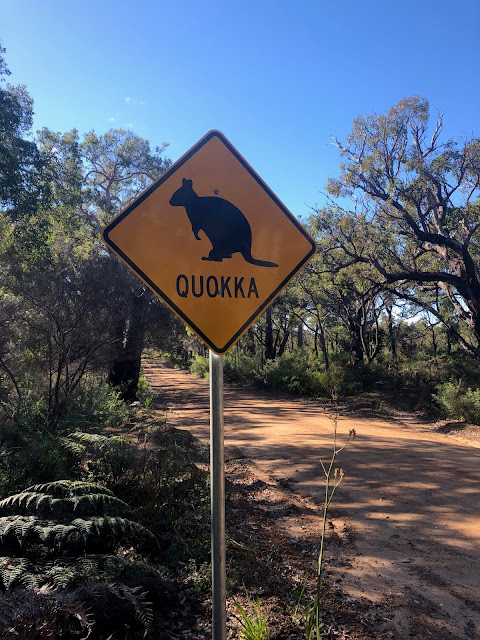
Someone from the shire put up this sign a few days ago, well I think it was them. Parks and Wildlife have denied any responsibility. It's just outside my driveway. While there are rumours of quokkas around here, I've never seen one. The most random thing about this sign is that it faces traffic on their way back out to the highway. You'd have to dodge these mythical creatures for ten kilometres on the way here before even seeing this sign.

The shire have been busy on the mountain road too. On one of my last journeys to the fire tower, I saw two similar signs; one of a horse and another a deer. Apparently there are feral horses and red deer out in those badlands. No mention of kangaroos, emus or feral pigs, though I see them every day.
Might write the shire a letter requesting a thylacine sign, seeing as they are definitely the main suspect (that I never see) in eating all the quokkas (that I never see).

Tuesday, May 19, 2020

The Sound of a Podcast


I'd almost forgotten what a ripping yarn this is. Rosemary Puddy who runs thebookpodcast has rerecorded my interview with her from a few years ago. Have a listen. It's great.
Here is the link: https://bit.ly/TBP019

Tuesday, April 21, 2020

Time? What's Time?


The bush fires were a long time ago now, and there are those words *time* and *now*. Back then I said to a friend that I felt our national psyche was injured. A summer of anger and hurt and death and culture wars. When the rains came, relief was palpable but the toxic run off over scorched country killed aquatic species. Pollinators were rare now and thousands of people moved into tents and caravans. Others organised food drops for surviving wild animals whose habitats were destroyed by fire.

That was January. By my 50th birthday mid-February, I think we had our last gathering of more than two people. Now I have a list on my fridge of things I have to do every day to maintain a routine. ‘Please Sarah! Go for a walk, write something, finish your mentoring job, read, sort out the mullet nets.’ In February, I was still going up the mountain every day on fire tower duty. I was preparing around then for the beginning of my uni classes at the Resource Centre. One morning on my way there, I stopped at the hardware to buy a gas bottle. A fighter jet buzzed the little town. The man helping me get the gas onto the back of the ute said, ‘that’s the fourth pass he’s done this morning.’ And as I strapped the gas to the aluminium bars, the jet did another pass. Odd.

At the Resource Centre, the work farm trusties set up the function room for a meeting. After big hello smiles, they continued moving about chairs, tables, plugging in the urn and laying out a table full of cups, teaspoons, sachets of sugar in little bowls. Dressed in their prison greens, they arranged cakes and slices into dainty piles. Over the clinking of crockery and quiet murmurs of the trusties, I heard the jet again.

Each day they ride mountain bikes from the work camp to town. They trim the gardens and water in new plantings at shire council and state government premises. They clean up sections of the hiking trail that snakes 500km from Albany to Perth. These guys are minimum security and approaching parole and theirs is a ‘soft entry’ back into community where once a week, there is a rush of green-clad shoppers wielding trolleys in the local supermarket, the guard standing by the ATM and watching them.

After setting up the function room, Marley (not his real name) sat beside the photocopier. The weekly community newspaper spewed page by page from the machine and he carefully folded each page in half. His job is to collate the newspaper and then distribute it around town. Marley is Iranian Australian. When he first arrived at the camp, he was aloof but polite and spoke quietly. I remember him talking to one of the other prisoners about world peace in his odd, nasal tone. Adenoids, I think. As he grew to know people in town, he warmed to them. These days I’m likely to see him stopping in for a chat with the mechanics or the librarian on his newspaper round. Other prisoners come and go as their sentences are served but Marley remains a green clad fixture. He is wrapping up a ten-year sentence for people smuggling; a one particular voyage that ended catastrophically.

There was a kind of buzz going on at the resource centre this day. The place began to fill up with uniforms. Local police, parks and wildlife, fire and emergency services. I went outside and sat on the bench under the peppermint tree. A hire car whipped past. I saw the driver do a double take at the centre, turn around and come back. Then a hire four wheel drive, then another. People began spilling from cars with cameras, laptop bags, talking on mobile phones. City clothes and the gait of a mission.

‘What’s going on?’ I asked the young man at the front desk.
‘Minister for Corrective Services’, he said. ‘Apparently they are making an announcement today.’ So maybe the Air Force jet was scoping?

Eventually the minister turned up and while I studied the new lectures and printed out class lists, the room next door crowded with various apparatus of the law, making media announcements regarding the justice system, and Marley stayed by the photocopier, collating the newspaper in his prison greens.

*Time* That scene was from another life. I haven’t seen the work farm trusties for three weeks and I assume they’re in lockdown. When I mentioned this to Flame and wonder about sending them books or postcards, some kind of support, she said, ‘Sarah, we’re all in lockdown now. It’s just … those guys are used to it.’

Time must operate differently for them, I think. The need for routine must be paramount. I too have a list on my fridge now. We all suffered the shock three (?) weeks ago when so many people lost their jobs and were forced home to contemplate. Time now seems to operate in graphs of curves and daily new infections. Time now works in blobs and spirals and pools. Back when the rain put the fires out, I would never have believed that dinner parties would soon be declared illegal or that citizens would actually consider installing a government tracking app on their phones. That having too many cars outside your house could mean a visit from the police. Driving the river bridge is now a crime where I live, unless you have an exemption. Linearity of time has been shown for the western furphy it is. Any historian can tell us that. Time is more like blowing apart a dandelion seed head with your breath, watching the individual seeds travel off on their own trajectories.

Sometimes I do an exercise with my students to demonstrate the ‘everywhen’ connectivity in Indigenous life. We stand in a circle and each person represents an aspect of Noongar culture. Katitjin/knowledge, Moort/family, Lore/law, Nyitting/Dreaming, Boodja/country, Gorah/time/long ago. We have a single ball of string and, holding the piece of string, throw the ball to the person who we feel is connected to what we represent. For example, I as Moort could throw the ball to Boodja, and so on. No decision is wrong. When the ball of string is completely unravelled, we are holding a complex, messy version of a cat’s cradle. Everything is connected.

I read somewhere on social media, an epidemiologist used to wonder as a science undergraduate why they were forced to do some humanities units – sociology, anthrop, philosophy etc. And they said, ‘I get it now. STEM and the humanities are connected, intimately.’

Everywhen:

Now
These days
Sometimes
Remember
Back then
Long time ago
Before
(?)
Weeks ago
Tomorrow
Maybe tomorrow
Next week
Winter
Maybe in Spring
2021