Showing posts with label Menang. Show all posts

Sunday, January 16, 2022

North and the Norsemen


This is facing north from the firetower. 360 degrees is just to the left of that granite queen of awesomeness called Burubunnup or Mount Roe. Back to her later. Out past Smythe Hill, it's really hard to judge distances because there are few landmarks and the country flattens out. Tricky country. I've come unstuck a few times seeing a plume of dark smoke go up, only to find it's someone working a tractor sixty or eighty kilometres away. Dust, smoke, sea mist and steam are all elemental particles and behave the same way in the air. It's easy to make a mistake and these days I forgive myself for calling in cloud and gravel road 'smokes', or I give the caveat in my report as 'it may be dust, but'.


 A lot of old maps had the original Noongar place names on them. We live in a country where place names, highways, roads and histories, even the seasons of the year have been supplanted, superimposed ... where one culture colonised another. I've read that one of the reasons the colonisers kept Noongar names, before extensive mapping of certain areas, was to ensure that they could find their way back to water holes or other spots using Noongar guides. The vestiges of old maps reflect this, whereas the more recent cartographers did away with the practice. Google maps ... well ... it works when in the city but pity the city tourist relying on it.

Recently we had lots of climbers come up the mountain. They freak me out a bit because I'll hear voices after hours of being alone (no not like that) and then suddenly some people will pop up from the western edge of the granite.


 'You guys are freaks,' I'll say as they walk towards me, all swinging crampons, grins, endorphins and ropes. 'Who even does that shit?' and then 'How do you deal with the march flies?'

I give them the binoculars and tell them to look at Burubunnup. There's no road there, or trail and they know it, but I can always see them slaver at the chance to climb that beautiful granite. I look at her every day.

Finally, my tower day today was pretty quiet and so I spent it listening to Seamus Heaney reading his own translation of Beowulf. Oh. My. God. This is probably the best version I've heard. My one problem, as with most Beowulf translations, is that Grendel's mother still doesn't get nearly enough air time.


Sunday, April 4, 2021

The Uluru Statement

 In 2017, Indigenous people gathered at this continent's heart Uluru to develop what is now known as The Uluru Statement from the Heart. Such a getting together from so many nations to clearly articulate a singular unity of purpose when it comes to our constitution and our national relationship to history ... it was mind blowing to me at the time. Imagine a collective of Indigenous peoples from the Europa continent doing the same thing, on the same day, with the same sentiment. 


They know they stand on the shoulders of giants.The Pallawah of Van Diemen's Land petitioned to the Crown in the 1830s that their treaty pleas had been ignored, and the letters from Corranderk, calling for a treaty and a voice in parliament, the Burunga Statement, the call for National Day of Mourning on the 26th of January, 1934, William Cooper et al. It goes on and on.

Anyway, after the statement being originally rejected by our then Prime Minister and kicked to the side by other ministers, who misunderstood the statement enough to say it would mean a third tranche of parliament (not true btw and some of those MPs have since apologised for 'not getting it'), the Uluru Statement is gaining traction again as a fair and true campaign for Voice Treaty and Truth. 

Out of the many British colonies, Australia was never ceded to British ownership by its people. There was also never a treaty. The Uluru Statement seeks to cut through that history in really practical ways: We need a makkarata, which is a reckoning and truth telling about our history. We need an Indigenous voice to parliament and this voice has to be enshrined within our constitution, so that any Indigenous advisory mob cannot be kicked out when the government changes hands or ideologies, which has happened in the past.

These statements are the voice from our country's oldest people. Their requests are simple and a profoundly generous solution to our way forward as a nation.

Here are some explainers on why the Uluru Statement is momentous. The first one is from Dean Parkin:


And the second one is the statement itself:


Finally, if any folk want to voice their support, please visit this spot where it is all happening and you can jump on board.

https://ulurustatement.org/

Saturday, April 3, 2021

Djeran skies

 Our season turned on the pin of the equinox. Woke up on the 22nd and the car was coated in dew. Any rain before this was fringing the cyclone systems up north and now soft rain and stilled winds tell us we are coming into the Noongar season of Djeran. The Southern Ocean country is pretty different to Indian Ocean country or inland though, and this season down south is translated by some as Pringren. This comes after the two summers and before we head into the two winters.

The other night I was sky gazing and thought ... 'Mare's tails and mackerel scales, tall ships with shortened sails' ... there would be a weather event in twenty four hours and so there was, although a vestigial thunderstorm of the second summer. The moon was amazing.


Wednesday, November 18, 2020

Stone Stories #3 Flint

 We walked for hours along the shore, past the stone fish traps, past the desiccated remains of a more ancient meteorite strike. We got to Signal Point where mounds of granite huddled together like huts. We stopped there for a lunch of boiled eggs and crackers, sitting on the beach sand with the stones as back rests. I tested out my theory there that we could dig into the sand for a layer of fresh water beneath the salt. My dog was thirsty. But it didn't work, the water was still salty and so I gave her a drink from my water bottle instead.


Last time I walked this far, I'd taken a diary, my camera and put a pelican feather in my hair. All these things were a bit silly I realised, after several hours walking. I hadn't used the diary, pen or feather and all I wanted was a drink of water and something to eat.


So this day, we had supplied ourselves sensibly. After lunch we left Signal Point and headed into the clay pan. This part of the inlet was mostly above water now. Blinding white sand for miles and miles, with a clutch of standing stones in the middle, like a pagan altar.


I felt quite exposed as we headed for the standing stones. It's like being in the desert. There was nothing to shield me from the sky and the whiteness was overwhelming. It's an incredible, dynamic landscape. Underwater, above water, fish and then no fish. We were looking for the stumps of trees from the drowned forest, back when the last great sea level rise was a big deal for the forest that used to live in this inlet. We found one, right before we got to the standing stones, a fossilised tree stump seven thousand years old.


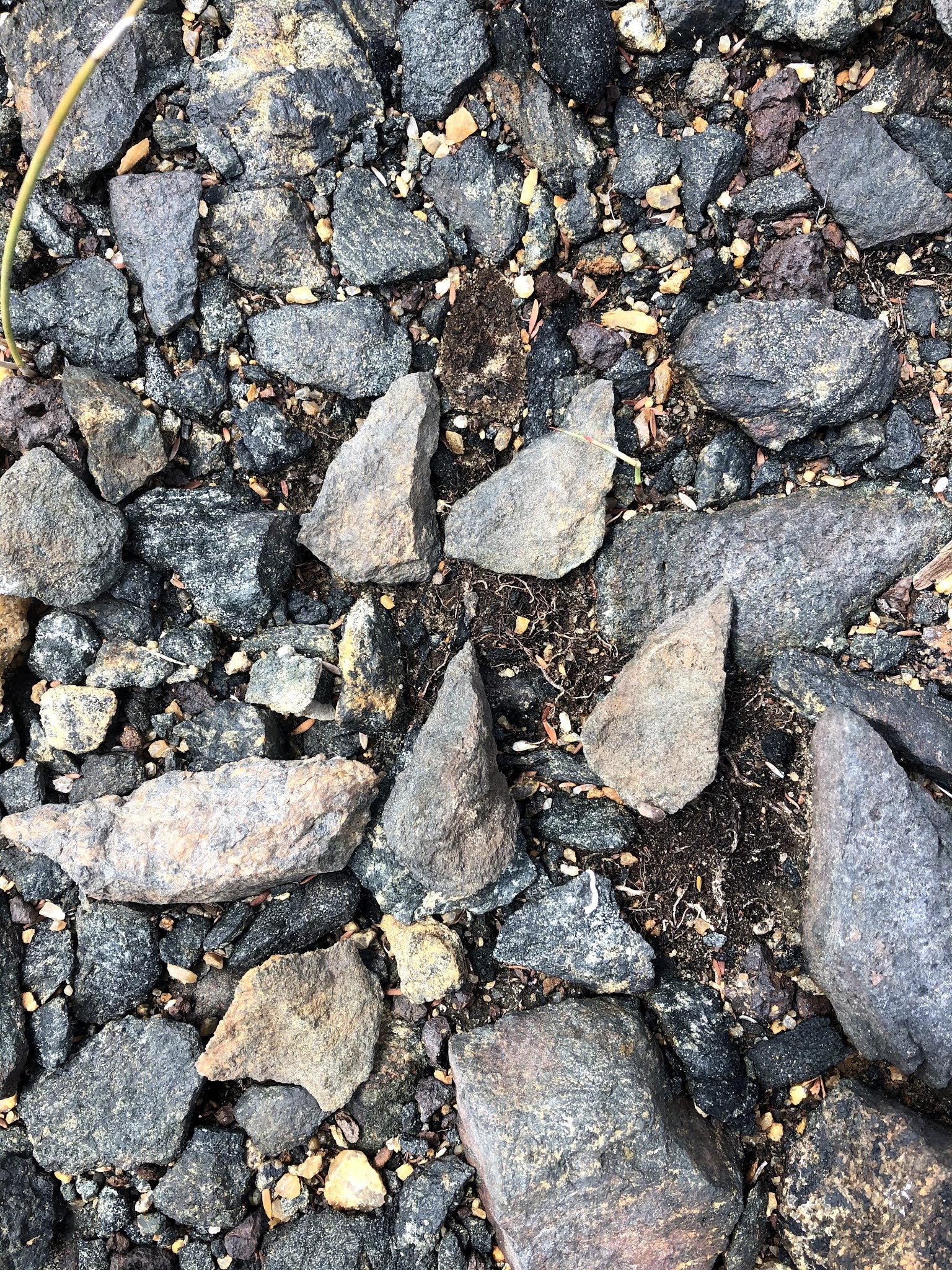
We also found some flints on the dried out floor of the inlet. They were knapped from a kind of quartz alien to here. I held the evidence of thousands of years, tens of thousands of years, of trade and commerce, in the palm of my hand. Someone had made these sharps, possibly from before the inlet was an inlet, and someone had brought the raw material here from somewhere else. It's quite a moment, coming across such physical evidence of occupation and it charged something within me. 'I must have it.'

Once again, when I talk about stones, I talk about ownership. The latest thing in Western ideaology about writing is to avoid anthropomorphism. I think this is a bit of a crock. We live on Boodja (or Country) and we all know it is a storied country, that there is history, culture and memory imbued within Boodja. The aversion to anthropomorphism is to deny that the landscape is peopled by critters other than ourselves or that humans are connected to this interchange of species. (I may leave this shit fight for another day now and move on).

What I want to say is that when I saw those flints, I did a total Bilbo Baggins when he discovered the covetous power of the ring.

 So I put them in my pocket and took them home. I put them on the window sill of my kitchen and wondered at them every day.

An ex boyfriend used to do this a lot, in fact he gave me many stones that had been knapped into flints, or the remaining shards from previous flints. He saw it as 'saving them' - from sea level change and incoming tides. 

When studying at a south island university in New Zealand, the Australian lecturer asked us students why there wasn't a more common history of handing in artifacts between the two countries. I was the only Australian student in the room and I knew why. 'European Australia is just discovering this thing called Native Title, through Mabo,' I put up my hand. 'People think if they find stuff on their property, that it will be taken away from them. New Zealand has a treaty.'

It's this problematic colonial relationship that began to bother me, as I looked at the flints I'd taken. If I'd left them in place, someone could work out later where they'd come from and what was going on those thousands of years ago. Sitting on the windowsill of my kitchen, well I'd taken the evidence away and put it somewhere else ... if I die, or if I left the flints in my garden ... who on earth will know where those stones came from? By my actions I was obfuscating history and also the legal processes of Native Title, which on thinking back, is pretty much a crime.

So, it was at this point I decided the flints needed to go back.

An Aunty came to visit me during the lockdown era. She brought her tiny flopsy mopsy dog and I was a little worried about this because Selkie is a big dog and tends to go for aggressive little Flopsies who try to attack her. Anyway, we had some ham hock soup and then headed for the fish traps.

As we walked along the beach, two sea eagles began stalking us. I could tell they were after Auntie's dog who probably looked like a rabbit. It was obvious they were hunting this little dog. I've never felt so afraid of sea eagles as I did that day. I had the flints in my pocket. I'd explained to Auntie that I wanted to put the flints back while she was here. She's an Aboriginal woman and agreed and, after we'd walked beyond the fish traps, I laid the flints down on the ground, and walked on. I could see that she pretended to ignore what I'd done. The sea eagles kept up their swirling patrol over head.

Monday, November 16, 2020

Stone Stories #2 Putting them back

A boy with brown feet and brown eyes has been hanging around me over the last few days. His parents and siblings are camping nearby. When I first met him he was trailing a thick sisal rope tied around his waist and was trying to tow the campervan away with his brute strength. Later, he followed Selkie back to my house. He carried two bamboo sticks that he’d been carving. We’ve spent hours going through my boxes of big and little treasures; jewellery, sharks’ teeth, whale bones and gemstones. He announced that the fossilised megalodon tooth and the smaller of the curved sperm whale teeth were his favourites.

‘What about Fergal?’ I asked him.

‘Fergal?’

‘Yeah, Fergal Sharkie,’ I said pointing to the stuffed carpet shark hanging on the wall.

‘Oh, he’s alright,’ he said. ‘But the fox skin is better.’

I could feel my seven year old alter ego swell with pride.

On the beach just down from the house are gemstones, clusters of tiny stones coloured like garnets and amber. The larger stones contain striations of gold and chocolate, kinda like those chef-endorsed ice cream brands. When the inlet fills, the corals and other critters colonise the stones, living all over or under them. Mullet feed on the coral aggregates. In the 1950s, someone built a break water for the boats. It’s possible they constructed it from ancient Aboriginal fish traps. Fish trap stones, concentrated in one place from hard labour a long time ago, are an easy source of stones. 

When the huts were all broken into a few months ago (read all about the dastardly Quokkas here), a lot of the hut owners came down to the coast to inspect the damage. Most of them live in far flung inland towns and having a hut ‘at the coast’ is one of those deliriously wonderful privileges open only to the generation previous to me. That is, unless you own several CBD premises, a city beachside house and a business that allows you to call yourself an interior decorator (ie you sell tiles).

So, I was out the back of Hyacinth and Rupert’s hut with them, inspecting where the thief had broken a window to get in, when I looked down to see stacks of Broke Inlet stones from the beach. There weren’t only a few stones. I was looking at hundreds, if not thousands. Given the earthworks, I gathered H & R had taken them from the beach to build a retaining wall. The corals snail-trailed over the stones were calcifying as they died. 

‘Where did you get those stones from, Hyacinth?’

‘Oh, we hauled them here,’ she said, striding away, ‘from somewhere else.’ Both were stressed about the break in and so I left her lie where it lay. It was obvious they’d come from the beach. One half of the wall was already cemented in.

After ruminating on the stones for a few weeks, I sent Hyacinth a text message. ‘Please put back the Broke Inlet stones. They are habitat for all kinds of critters and should stay where they are. They’ve provided homes for invertebrates and fish for tens of thousands of years and you are using them for a retaining wall? Really?’

Didn’t hear back.

Another month. I bailed up the Parks and Wildlife ranger outside the Post Office. ‘Here’s a hypothetical for you .. say someone was building a retaining wall at Broke Inlet, using the stones from the beach …’ She looked at me warily. ‘Look,’ I said. ‘I’ll get rinsed if I dob anyone in. It’s the Code of the Coast. What happens at the Coast stays at the Coast. But I know this is wrong. How do I change their minds about this? Is it actually illegal?’

It is illegal to remove any natural material from below the low tide mark, according to the 1984 CALM Act, an Act I’ve always railed against, but anyway. So, I sent another text to Hyacinth. ‘Would you like me to save your backs and a criminal conviction? I’ll put the stones back myself if you like.’ 

For someone so status oriented (I haven’t called this character after Hyacinth Bucket for nothing) she sure kept her cool. She replied that her and Rupert had so many family issues going on right now, they would deal ‘with the problem as soon as humanly possible.’

While I was glad ‘the problem’ had been recognised as a problem, I began to entertain doubts about my stand. Yowie changed the subject whenever I brought it up, as did other squatter hut dwellers. Maybe they thought I was a crank or a control freak. Maybe I was wrong? Maybe I was one of those tree changer newcomers who starts up a ‘Friends of XXX’ group and becomes a total pain in the bureaucratic arse? I asked Flame’s partner, an old-time resident, what he thought. ‘No, it’s fucked,’ he said. ‘They’ve got enough money to buy whatever they want. They just felt entitled to take those stones. It’s fucked.’

‘As soon as humanly possible’ involved Hyacinth and Rupert cementing the rest of the Broke Inlet stones into the retaining wall the next time they came down from the city. When I saw the slopped cement over the corals and the stones, I felt disappointed in them and in myself. All I wanted was for us all to be better people.

No one at the inlet wanted to talk to me about it anymore. ‘You’re like a dog with a bone about this,’ said the squatters who’d agreed with me previously. Outsider folk said, ‘Well I’m glad you are taking up the fight. I can’t do conflict, myself, so thanks for taking this one on.’ But they had no idea what it is like to live here.

I’d just alienated my only neighbour within 25 kilometres. Hyacinth and Rupert have helped me out in the past but now they disappeared into their hut as soon as I drove past. The last message I sent to them was; ‘Hi just letting you know I’ve dismantled part of your retaining wall and returned the stones to the beach. When you are next down, I’d love to talk about dismantling the rest of the wall and putting the stones back. Sarah’ 

I did that on a Sunday afternoon long weekend, in fuck-it mode, in front of everyone.

I went into Albany after that and learned that Hyacinth and Rupert would be back that week. Hyacinth slunk into the hut when I returned (I doubt she will ever speak to me again) and Rupert, once he’d gone behind the hut to inspect my wilful damage, came out to glare at me. ‘Would you like to talk tonight about returning those stones?’ I asked him. I was expecting that a good dose of valium would get me through this encounter.

‘There’s nothing to talk about Sarah.’

‘Really?’

‘You took one load back to the beach. We took another two. We built the retaining wall out of quarry stones in the end.’

‘That is the BEST possible outcome Rupert!’ I said. No valium required and I kinda half believed his yarn. Big sigh of relief.

And then he offered me some bull herring and I thanked him.

I have more to say about the taking of stones. It's a biggie in this country and yes, I’ve done it myself. This is just one story and I’ve had a great few days, hanging out with a kid who appreciates stones as much as I do.


Saturday, November 14, 2020

Stone Stories #1

The serpents were fighting again, this time over eggs, their own eggs or maybe it was the muttonbird’s eggs, laid in burrows on the island. They writhed and rolled through the sound, smashing boulders and letting the water in to the place where once there was a wooded valley with a creek running through. Jarrah maybe. I don’t know. It’s been flooded for a while now and that was all the work of the snakes.

One of the water snakes shone like paua shell, glossy with the rushing water, given the incoming tide. The other snake could see her reflection in her partner and tormentor. Her skin was reddish brown like the bloodwood kina and soon, after he bit her and slid back to examine the wound, in a rare moment of comradery given what had been happening for the last seven days, nodded to her as she watched her wound sprout blood in the mirror sheen of his hide.

She wanted to kill him then, kill his glee in her damage and, knowing she could never kill him, that killing her fellow progenitor would cause their mutual extinction, she burrowed into the earth to escape. Her skin became ruddier as she nosed through deep black sand and deeper into the white sand of sea dunes. She swam under the mountain, beneath granite tors and found the underground stream, followed the stream gulping at the sweet water rich with minerals to keep her going. Behind her, there was a rumbling sound. 

He followed the path she made under the mountain and then swam along the underground stream, now red with her blood. He knew from the dank scent that she was failing.

She burst out the north flank of crow mountain. She asked the people to help her. They wore cloaks and stood in a small circle, looking shocked, their sticks shipped to their sides. We don’t dare, one of them said. What if he comes after us next?

Distract him then, she said as the rumbling under the mountain grew louder. She slid away, through the reeds of the wetlands, past the Big Tree and into the creek. She knew this creek flowed into a lake filled with yakka tortoises. She knew this because she had made it herself. Dug it out to let the water flow when the water rose up that time. Here and now, she rested a bit, hoping the people would make good on their promise. The little fish gathered, nibbling at her body, and it felt like a sweet massage.

When he came out of the mountain, he wasn’t gasping like her. He emerged straight into the sky, his colours pulsing in the sun. Where is she? He asked the people and they just looked at him. They didn’t seem to know what to say. A kid with windblown hair raised her arm, like she was about to point out the lady serpent but she was cuffed and she dropped her hand and looked at her feet. He looked down and saw the track of brushed aside rushes in the wetlands. He was fully emerged from the mountain now and towering above them. Where is she?

One man picked up his dog, cradled the dog, whispered into its ear. As the serpent took off through the rushes, the man threw his dog into the air. The dog howled and flailed as it landed in the serpent’s path. He had to either go around the dog or stop to inspect a likely feed. He bit the dog in half, swallowing the torso and flung the tail and the head back at the people in reproach.

*

The rock in the shape of a dog’s head stands in the place where all that business with the serpents happened. The main road runs so close to Dog Rock that the town council painted a luminous white collar around its base, ostensibly so drivers don’t run into it. The rock sells postcards, advertisements for car yards and tourist moments. Whenever there is talk about removing the collar citing cultural concerns, the council overrides, citing safety concerns. Yarn bombers knitted the dog a new collar and that was removed, citing safety concerns. 


Two hundred metres south is the church, attended on Sundays by processions of families and led by men in robes, carrying sticks. Outside the church is the dog’s tail. It’s a tall, upright monolyth of granite. A rectangular cavity was carved into the dog’s tail and inside that grotto stands the Virgin Mary. 

Recently, but not so recent as the epic battle between the snakes, someone stole the Virgin Mary. The thieves carved away the concrete that bound her feet to the granite, and took her away. It was considered by many as an act of desecration.

There are rumours of tunnels under the crow mountain, dug out during the war to help soldiers move around unseen.