Wednesday, January 31, 2018


Caldyanup Diaries #1
At the car park, the forest smells mushroomy and damp, despite the plumes of gravel dust drifting like smoke away from my old car. I double check for tower keys, phone, water. One climb a day is enough.
The first bit of track is quite civilised, black bitumen littered with karri leaves. I pick up the stick I'd thrown by the path yesterday. The stick serves to help me along later and also make me feel better about the snakes. The north-facing Caldyanup track is their morning powering up spot. It gets steeper, past a face of granite that is almost emotional in its gravitas, an interpretive plaque squatting at its base.
At the foot of the steps another plaque tells me that the rest of the climb is not for the faint of heart or foolhardy. I always wonder at this: is it a dare to the faint of heart or foolhardy to defy the advice. I don't get it. It's time to take off my jacket, tie it around my waist and shoulder my pack again. This is the only time I stop on the climb. Of all the little rituals to the beginning of a day's work, this one feels almost superstitious. If I stop it's harder to get going again and anyway I'm aiming for a faster time than seventeen minutes.
By the first ladder I'm pretty puffed out but the two ladders allow a cardio reprieve, so long as my stick doesn't get tangled in the rails and send the soles of my feet tingling crazy. More stairs, concrete slabs with initials etched in and I wonder at who lugged up those bags of cement. I use the stick now to haul myself up the stairs, past the grass tree bleeding resin.
Seventeen minutes, again. At the peak, it is so good to wash my flaming face in the little rock hole, then face the wind and have a look around. There are two fires out there that I know of. I can't see them with the naked eye but I know they are there.
The little brown skink that I feed blowflies to lolls about on the step of the tower but slips under the door when I get out my keys. I open the door cautiously - snakes get in here occasionally - and check the first floor of the tower. Push up the hatch, throw up my back pack and water bottle, climb the little ladder.
I wind up shutters north, east, south and west. A gecko slips away as the light glares in. It's really clear today, visibility is ones all round. I can see the Stirling Ranges 145 kilometres to the west and Mt Chadalup to the west. I can see the inlet where I live, lying out across the country like a slip of silver paper.
Beep beep and the radios are on. Spotter pilots from nearby districts are calling in their position and the tower becomes thick with static and 'roger' and 'copy that Spotter'.
'Office, this is Tower.' I wait with the radio, scanning the hills.
'Go ahead Tower.'
'Hi Office, Tower is up and running for the day. Visibility is one all round. Standby for smoke report.'
'Roger Sarah, Tower open.'


Sunday, January 21, 2018
Free Flea Exchange
She really is a lovely dog but she smells. A lot. When I go to work, I know she creeps onto my bed because I can smell that funky scent in my sheets later. The bloody dirtbag even pulls back the covers. Apparently her scent derives from being short haired: the oils she produces to stay warm kind of go off after a while. When she gets bad, we go down to the inlet shore and I throw out a stick. She fetches it, I rub dog shampoo through her coat and throw out the stick again. The simple life.
Her and the cat have their daily fight, often in the evenings. She growls, howls and snakes her neck at the cat, inching closer and swinging her claws at the cat. Close, but never too close. Haunches in the air, tail waving. Cat growls, fuck off you baby punk, and retreats under the bed where she can strike better at the dog in the dark.
I patted them both goodbye yesterday morning on my way to the fire tower, started up the car and got a hundred metres down the corrugated travesty of a track when I realised there was no phone to plug into the car charger.
I walked into the house and there on my bed, set up in the living room next to the fire, was the dog and the cat, lying curled around each other like two commas.
Monday, January 8, 2018


Thursday, November 30, 2017
Mainbechup Tales
Prickle and the Octopus
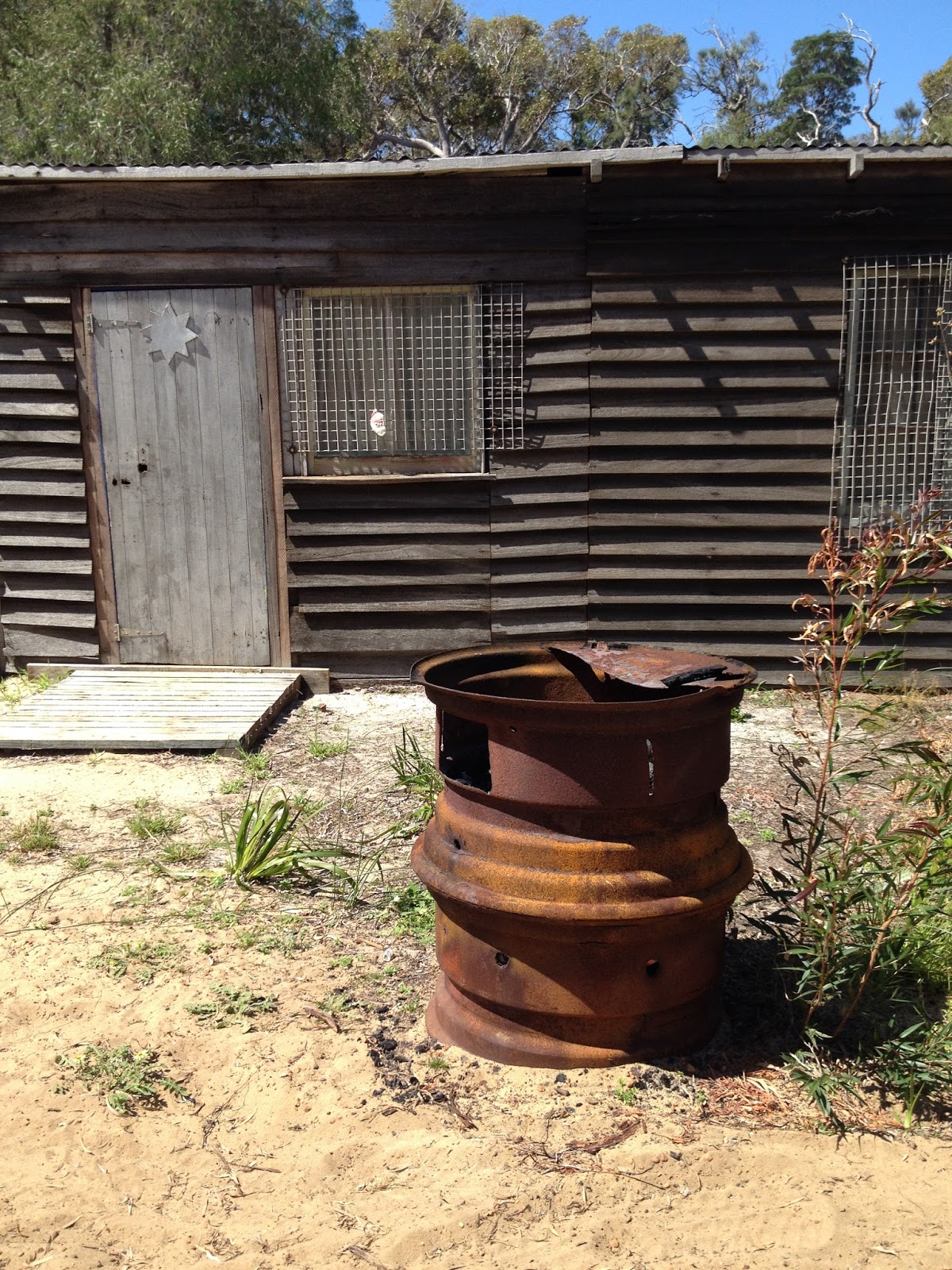
At the inlet the row of squatter’s shacks faces
The Cut at the coast like the main street in a western. Rough jury-rigged
shacks, each one singular in appearance. Some people say that they feel
unwelcome or uncomfortable here.
Old Mrs Norris certainly never returned once
she found out the previous owner of her family’s shack, Prickle, had died in
there. ‘They found him three days later,’ Meadow Man told me. Apparently, they
worked out the time of Prickle’s death by the state of the prawns Prickle had left,
uncooked, in a bucket in the kitchen. The cause of death, well, ‘There was a
blue ringed octopus in the bucket too.’
Scattering is easier than gathering.
Peppermint flowers coat the ground like hailstones,
pepper my hair too. Karri hazel flowers are misty, ethereal sprays of pink and
white under the canopy, and the solya are berrying up. Thousands of brilliant
blue dragonflies cling to reeds, all lined up facing into the wind. The roads
are busy with ravens after the smashed bugs. The black blood bruise on my
thumbnail, inflicted on the cuticle while chopping wood in the dark month, reaches
journey’s end this spring. Burning season begins.

The tombolo and the fish trap
When the inlet was cut off from the sea by a
sand bar, it was the end of a millennial relationship where river and sea were
always acquainted. She was a moving water then, and ruled by the pull of the
moon. People built graceful arcs into the inlet with stone two courses high.
For three thousand years they trapped fish behind the stone walls as the tide
fell.
‘How did the traps work, if the inlet is only
open and tidal for a month a year?’ I asked Meadow Man.
‘Back in the old days the bar was always open,’
he said.
‘Where did you hear that?’
‘The old people told me.’


Old Whacker, getting sucked out to sea when
the bar breached, stood at the tiller ‘like a Viking’, his brother said. His
brother had jumped overboard and made it to shore. Whacker was never seen
again.
Swan skein
The swans are back, though they don’t feed near
my home. The water here is too deep for their cockle foraging. But I hear their
chatter as they fly over the inlet to the shallower cockle fields.

The inlet feels like a Borderlands, a space in
between. It is a puzzle of a place and sometimes I wonder if it grieves its Old
People the way The Secret Garden grieved the children who once within its
walls. If Tindale was right, then the gravel track from the highway to the
inlet roughly marks the boundary between two nations. But the inlet, the
islands within and the country, they are fiercely loved by the shack people who
know the place intimately these days. And yet even they say that some 'strange
things have gone on around here.'

The
bar opened for a few weeks in August but it rained so hard this winter that the
inlet swelled again, looking like it might have broken twice. But it didn’t, it
just filled up, though not tight as a drum when it is ready to blow. Whacker’s
men dug for two days because they don’t like the water so high, and failed.
This failure made me happy because I can swim in the inlet in the coming summer
and it is like swimming in warm, black tea, clean, a faint taste of tannin.

Tuesday, November 7, 2017
Straight to the Dublin
I
was on my second last day at work. It was the middle of winter. I say on my TWDS
bio here that I work in a service station and write stuff but only the latter
is true these days. Mmm. Fix your bio Sarah Toa. Write instead, ‘writes’ because
that is all I am doing at the moment. Living from my savings, writing. Setting nets
and setting fire to things.
Anyhoo,
in July, when I was on my second last day at the service station, I got in
after dawn to open up the shop and prime the coffee machine. There was an
invoice addressed to me lying on the day book. It was a bill for the honey I’d
bought from my boss. Plastic pails of honey due for the shop shelves had been
damaged in transit a few weeks beforehand and I’d bought several kilos at cost
price. Boss couldn’t work out the correct amount at the time, and we’d let it
slide until the business was sold and I got laid off and it was my second last
day at work.
Getting
the bill for thirty dollars’ worth of honey would normally not have rankled me.
I don’t mind paying for things I’ve bought. But the invoice was grinding against
the fact that in the eighteen months I’d been making coffee in the adjoining
cafe, I never saw a single tip. I mean, I did see them, tinkling silver and
gold into the cut-glass tip jar, but I never received any. Every month the tip
jar was emptied and stashed in some mysterious parallel universe that did not
involve us humble baristas and service station toilet-cleaners. Anyone in
charge went vague or uncomfortable when I began my difficult, querying, Sarah-assholery
as to what was actually happening with the tips.
On
my second last day I received the honey invoice but still no bounty of tips.
Boss was nowhere to be seen, I was on my own and it was a tumbleweed midwinter
sort of day. I didn’t feel graceless enough to indulge in burning bridges down to
the waterline, so I had one act of resistance left. When I’d finished raising a
lone fist to workers’ solidarity, I settled down to scroll through my phone.
I
stood at the counter and read the ABC news and my Twitter feed. I think I even
had a look at A WineDark Sea. One of the local blokes came in and bought a
newspaper. ‘Correct weight,’ he said, putting one dollar fifty on the counter.
I rang it up. Cha-ching. Then I checked my emails. Amongst the dross, one email
stood out. It was from my publishing house with the heading: URGENT 2018
International Dublin Literary Award.
The Sound had been nominated for
the award that was previously called the IMPAC. If it was deemed as fitting the
criteria, the book would go straight to a longlist on November 6th. ‘Can we go
ahead with this?’ wrote the publicist.
I
looked back over the email she’d forwarded to me. State libraries from all over
the world can nominate up to three novels for the award. Out of the hundreds of
international entries, the judges will whittle down a shortlist, announced in
2018. Info was embargoed until the longlist was decided. I’m not one to use
Jesus’s name as expletive or exhortation, but the ramifications of my book being
longlisted for one of the richest literary prizes in the world made me breathe
out his name. Silently.
‘Congratulations,’
the email ended.
 |
| The judges of this year's award |
I
was still amazing over the email when FIFO Frank, returning from his swing away,
came in for a coffee. ‘What’s going on?’ He asked.
‘Oh,
not much. It’s my second last day at work.’
Frank
looked alarmed and adjusted his beanie. Obviously, the Bush NBN (previously known
as the Telegraph) had failed him while he was away. When I explained about the
business changing hands, he said, ‘This is really bad. I don’t like change.
It’s not good Sarah. What are you gonna do?’
‘I’ve
got some things lined up,’ and it was true. At the time I was just about to do
a month-long writer in residence in Perth, and I was looking forward to a
summer spotting for fires from a tower at the top of a mountain. ‘There is more
to life than pumping fuel and making coffees.’
There is something very cool
about The Sound going straight to Dublin,
city of literature. Today I am finally able to say that my book has been
longlisted for one of the biggest literary prizes In.The.World. I’ve been just
popping with this information for months and unable to say anything.
‘It’s
okay, Frank,’ I said, as he stumped out of the shop, clutching his flat white.
‘Well,
I’ll seeya,’ he said.
Despite
my newfound literary self-esteem, I was still fixating on those missing tips. I
knew I made great coffee and that I was often the first smile the old blokes
saw in the morning. So, two days after my last day at work I went into the
shop. My ex-boss was there and I put the honey invoice on the counter in front
of him. ‘I’d like to pay for the honey but I’d also like to ask you about my
tips.’
He
started prevaricating, ‘Well, we were
going to take you all out to dinner with the tip money but …’
I
waited, listened him out. Looked at him. Finally, he picked up a biro and
signed off the honey invoice as paid.
And
I’m listed. LISTED!!! Here is some more info on this year’s InternationalDublin Literary Award.
The Sound was nominated by the State Library of Western Australia (Thanks guys), with the librarian commenting: ‘This is an exquisitely beautifully written novel. I could smell the ocean, and feel the sea air, whilst being transported to a historical period I knew nothing about. A rare author who is able to bring historical events and people vibrantly alive. Not since Tim Winton’s Cloudstreet have I so loved a fiction book.’
Subscribe to:
Posts (Atom)